
Google Ads for Aesthetic Clinics: The Complete Guide
Google Ads for aesthetic clinics works when three things are true: the campaign targets people who are ready to book, the landing page and follow up convert them, and the owner gives it long enough to compound. Most clinics get one of the three right. I’ve managed more than a million dollars of ad spend for clinics and run campaigns for my own, and the pattern of failure is almost always the same. This guide is the whole thing, from what you’re allowed to advertise to the week six decision.
Should an aesthetic clinic run Google Ads at all?
Yes, once the process behind it converts. Search ads reach people with intent, which no other channel does as cleanly. They’re also expensive per click in most Australian cities, so a clinic that replies slowly or runs unstructured consultations will pay full price for enquiries it then loses. Fix reply speed and follow up first, then switch on ads.
The case for Google Ads is simple. Someone typing “laser hair removal Parramatta” or “skin clinic near me” has already decided they want the treatment. They’re choosing a clinic. Appearing at the top of that search, with a clear offer and a fast reply, is the closest thing to a queue outside your door that marketing can produce.
The case against is equally simple. Clicks in aesthetics aren’t cheap, the platform will happily spend your budget on clicks that never become consultations, and a clinic converting 20% of enquiries into consultations is paying five times what it should for every patient. Ads amplify whatever process sits behind them. Read how to grow an aesthetic clinic first if you haven’t fixed the leaks.
What are you allowed to advertise on Google?
Device treatments, skin treatments, consultations, practitioner expertise and the clinic itself. Prescription-only injectables can’t be advertised to the public under the TGA Advertising Code, so brand names are out of ad copy, keywords and landing pages. Google’s own healthcare policies sit on top of that and restrict prescription medicine advertising in Australia.
This surprises owners who see competitors bidding on brand names. Those competitors are creating a compliance problem for themselves with the TGA and AHPRA, and often having ads disapproved by Google as well. It’s not a loophole.
What works instead is advertising the concern and the consultation. Someone searching for a branded injectable is searching for a result, and a compliant ad that offers a consultation with a named practitioner for that concern captures the same intent. Device treatments, which are registered with the TGA and can be named and priced publicly, carry the direct response weight. Laser hair removal, skin needling, IPL, body contouring, skin treatments. These are the campaigns that bring the fast return.
All the rules from the AHPRA advertising guidelines post apply to ad copy. No testimonials, no “safe” or “painless”, no guarantees, terms stated on any offer, and total prices including GST if you show one.
How should the campaign be structured?
One search campaign per treatment or concern, with ad groups by intent, tight location targeting, and a negative keyword list you actually maintain. The structure decides whether the budget goes to people who can walk into your clinic or to people three states away comparing prices.
The build I’d use for most clinics:
One campaign per treatment you want to fill. Laser hair removal, skin treatments, body contouring, consultations. Separate campaigns mean separate budgets, so your best performer can’t be starved by your worst.
Ad groups split by intent. “Laser hair removal near me” and “how does laser hair removal work” are different searches. The first wants to book, the second wants to read. Bid on the first, write a blog post for the second.
Location targeting set to the radius patients actually travel from, usually 10 to 20 kilometres in a city, wider regionally. Check the location report monthly and exclude suburbs that click and never book.
Phrase and exact match keywords rather than broad. Broad match hands the platform your budget and a suggestion.
Negative keywords added every week from the search terms report. “Free”, “course”, “training”, “jobs”, “at home”, brand names of suppliers, and every treatment you don’t offer.
Ad copy that names the treatment, the suburb, the practitioner type and the next step. “Laser hair removal in Parramatta. Nurse led, medical grade, consultations this week. Book online.”
Call extensions with call tracking, so phone enquiries from ads are counted and recorded.
Google will suggest you turn on broad match, Performance Max and automated everything. Say no until you have six months of conversion data. Automation works on data, and a new account has none.
What should the landing page do?
Match the ad, answer the question, and make booking or enquiring the obvious next step. Someone who clicked “laser hair removal Parramatta” should land on a page about laser hair removal in Parramatta, with the practitioner, what a session involves, what it costs, and a booking button. Sending ad traffic to your homepage wastes most of it.
The page needs five things. A headline that repeats the search. Two or three sentences on what the treatment involves and who it suits. The price for a session and for a course, total including GST, or a clear explanation of what determines it. The practitioner’s name and registration. A booking or enquiry step that works on a phone at 9pm, with the reply arriving in seconds. That last part is where most clinic landing pages fail, and it’s covered in the speed to lead post.
Keep the page compliant. No testimonials, no before and afters unless they meet the conditions, risks and recovery mentioned for anything higher risk. A landing page is advertising.
How do you track Google Ads to booked treatments?
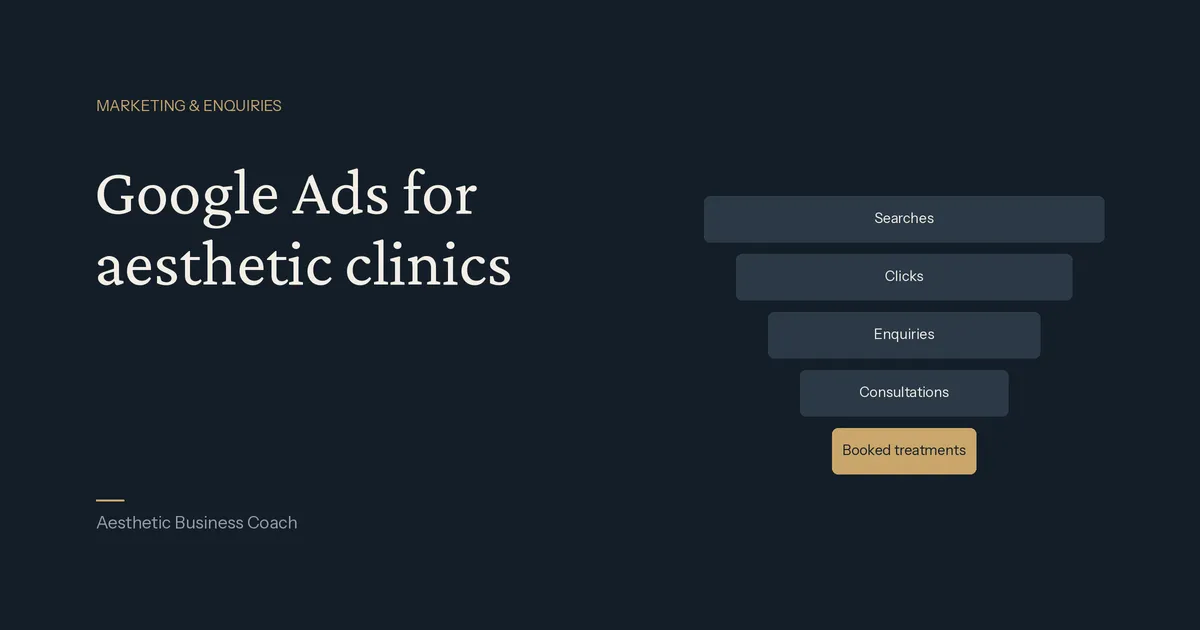
Count consultations booked and treatments completed, not clicks or form fills. Conversion tracking on the booking confirmation, call tracking on the phone number, and a CRM that records where each patient came from. Without those three, you’re judging the campaign on the wrong number and you’ll make the wrong decision.
Most clinics judge ads on cost per click or cost per lead. Both are stepping stones. A campaign with cheap leads that never book is expensive. A campaign with pricey leads that book and return is cheap. The only figure that settles it is cost to win a patient: total spend divided by patients who actually had a treatment. Compare that against what a patient is worth over a year, which the patient lifetime value post walks through, and the decision about whether to scale makes itself.
The tracking setup:
Conversion tracking fires on the booking confirmation page or event, not on the landing page.
A tracked phone number on the landing page and in the ad, so calls are counted and recordings can be reviewed.
Every enquiry lands in a pipeline with its source attached, and moves through consultation to treatment, so you can see which campaign produced which patient. This is what ClinicOS does out of the box.
A monthly report with four lines: spend, enquiries, consultations, treatments, by campaign.
If your current agency reports on clicks and impressions, ask for those four lines. If they can’t produce them, the campaign isn’t being managed to the number that matters.
How much should a clinic spend, and what’s a good result?
Enough to get statistically useful data, and no more than cash flow allows. A good result is a cost to win a patient that sits comfortably below what a patient is worth in their first year. There’s no universal benchmark, because cost per click, treatment prices and conversion rates vary by city and clinic.
I’m wary of published cost per lead benchmarks for aesthetics, because the ones I’ve seen are either old, American, or from agencies with something to sell. Work out your own instead. Decide what a first year patient is worth, decide what share of that you’re prepared to spend to win them, and that’s your target cost to win a patient. Then run the campaign, measure, and adjust.
On budget: start small enough that a bad month doesn’t hurt and large enough to produce a few dozen clicks a week per campaign. Too little budget and you’ll never get enough data to judge. Once cost to win a patient is stable and below target for two months, increase in steps.
Why do results take longer than the ads say?
Because a campaign needs weeks for the follow up sequence to convert the people who enquired but weren’t ready, and most owners judge it in days. Week one produces enquiries. Week three produces the bookings from week one’s maybes. Week six is when you can see whether it works.
In my second year of clinic ownership I launched a campaign I was certain would change everything. New landing page, new creative, a follow up sequence I’d rewritten four times. It went live on a Monday and I refreshed the inbox every ten minutes.
By Thursday I had modest enquiries and no bookings I could trace to it, and I’d decided it was a failure. I had a notepad open with the next idea and I was drafting the email to switch the ads off.
That evening I had dinner with a mentor, a clinic owner twenty years further on. She asked how it was going. Badly, I said. She asked how long I’d given it. Four days. She laughed and said the thing I now say to owners at least once a week: you’re judging a half built bridge for not reaching the other side.
I let it run, mostly out of embarrassment. Week two was a little better. Week three, the follow up sequence started converting the maybes from week one, who had needed exactly that long to decide. By week six it was the best performing thing I’d ever done, and it stayed that way for two years.
Budget for the middle. Six weeks minimum before a verdict, with the follow up running the whole time. Most owners cycle through tactics forever because they’re always in week one of something new.
What are the most common Google Ads mistakes clinics make?
Sending traffic to the homepage, bidding on injectable brand names, leaving broad match on, never reading the search terms report, judging on clicks, and killing the campaign in week one. Any one of them wastes half the budget. Most clinics I audit are making three.
A few more that cost less but add up. Running ads to a phone number nobody answers at lunchtime. No call tracking, so half the results are invisible. Ads pointing at a booking page that needs an account to use. Location targeting set to “people interested in” rather than “people in”, which quietly spends money on tourists. An agency that owns the ad account, so when you leave, the data leaves with them. Own your account. Always.
If you’d rather someone else ran it, that’s what our ad management does, tracked to booked treatments and with the follow up system attached. What’s included in each plan is on the pricing page.
Frequently asked questions
Do Google Ads work for aesthetic clinics in Australia?
Yes, for clinics with a process that converts enquiries. Search ads reach people who’ve already decided they want a treatment and are choosing a clinic, which is the highest intent traffic available. They fail when the clinic replies slowly, sends traffic to the homepage, or judges results in the first week. Fix the process, then run the ads.
Can I advertise anti-wrinkle injections on Google Ads?
You can advertise the consultation and the concern, but not the prescription medicine. Brand names can’t appear in ad copy, keywords or landing pages under the TGA Advertising Code, and Google’s healthcare policy restricts prescription medicine advertising in Australia. Device treatments can be named and priced, which is why they carry most compliant campaigns.
How much should a clinic spend on Google Ads per month?
Enough to produce a few dozen clicks a week per campaign so you get usable data, and no more than cash flow comfortably allows. There’s no useful universal figure because click costs and conversion rates vary by city and treatment. Set a target cost to win a patient from what a first year patient is worth, then scale in steps once you’re consistently under it.
What’s a good cost per lead for an aesthetic clinic?
The wrong question, because a cheap lead that never books is expensive. Judge campaigns on cost to win a patient: total spend divided by patients who had a treatment. Compare that against what a patient is worth in their first year. Published benchmarks for aesthetics are mostly old, overseas or from agencies with something to sell.
Should I use Performance Max or broad match for my clinic?
Not until you have at least six months of conversion data. Both hand decisions to automation, and automation needs data to make good ones. A new account with phrase and exact match, tight location targeting and a maintained negative list will outperform an automated campaign until there’s enough history to learn from.
How long before Google Ads results show for a clinic?
Enquiries within days, bookings within weeks, and a fair verdict at six weeks. The follow up sequence converts enquiries who weren’t ready on day one, and that takes two to three weeks to show. Owners who switch off a campaign in the first week usually kill the one that would have worked.
Book a free 45 minute discovery call
Bring your last three months of Google Ads spend and your bookings from the same period. We’ll work out your real cost to win a patient, check the campaign for the six common mistakes, and decide whether the next dollar should go into ads or into the process behind them. Book your discovery call here.