

Speed to Lead: Why Your Clinic Should Reply to Every Enquiry in Under 5 Minutes
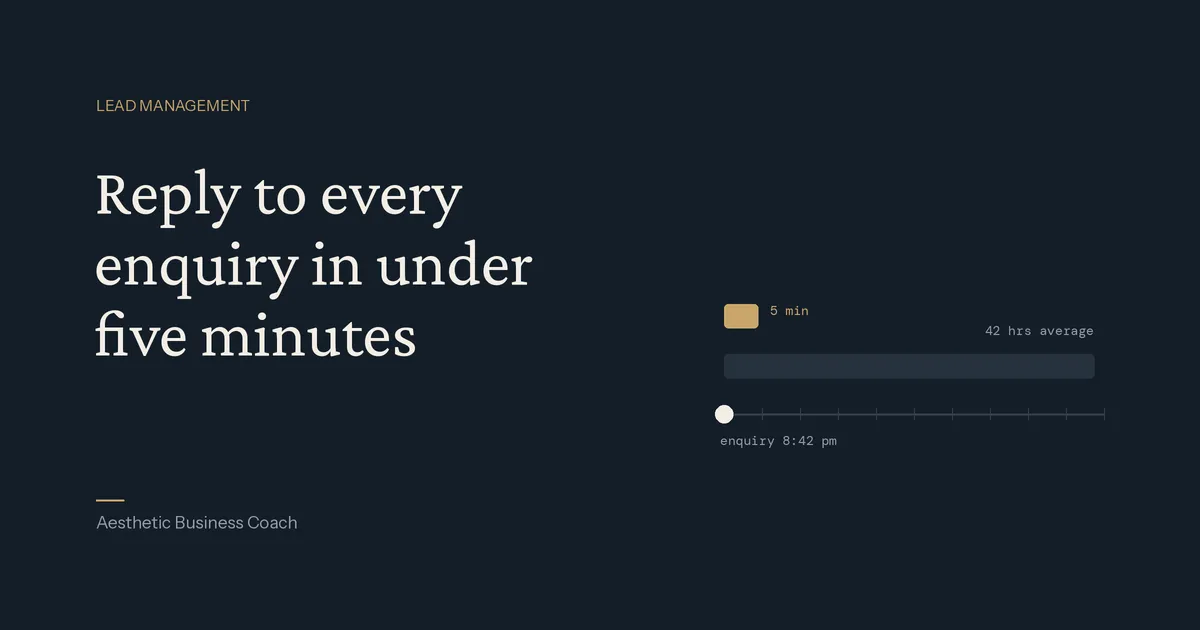
Speed to lead is the plainest growth lever in an aesthetic clinic and the one most owners never measure. A patient fills in your form at 8:42pm. When do they hear from you? If the honest answer is “when someone checks the inbox in the morning”, you’ve lost a share of them to the clinic that replied at 8:43. I ran clinics for more than a decade before I fixed this, and the fix took an afternoon. Here’s what the research says, why your front desk can’t do it alone, and how to set it up.
What does speed to lead mean for a clinic?
Speed to lead is the elapsed time between a patient’s first enquiry (form, chat, missed call, DM) and your clinic’s first real reply. Real means a response to their question, or a conversation opening, sent by a person or a system. An auto-reply that says “thanks, we’ll be in touch” doesn’t count.
Clinics are unusual here. A patient thinking about a treatment has often been thinking about it for weeks. The enquiry is the moment that thinking turns into action, and it usually happens outside your opening hours, on a phone, with two other clinics’ tabs open. If your reply arrives the next morning, the moment has passed. They may have booked elsewhere, or simply lost the nerve.
The metric to track is the median time to first reply, measured across every channel, including after hours. Not the average, because one enquiry that waited four days hides forty that were answered in a minute. And alongside it, the percentage of enquiries that never received a reply at all. In my experience that second number is the one that makes owners go quiet.
What does the research say about lead response time?
Two studies are quoted constantly, usually with the wrong attribution. A 2011 Harvard Business Review audit found most companies took hours to reply and nearly a quarter never did. A 2007 MIT study found the odds of reaching an enquiry collapse between five minutes and thirty. Both were American and mostly not about clinics. The direction is what matters.
The HBR audit by James Oldroyd, Kristina McElheran and David Elkington sent a test web enquiry to 2,241 US companies and timed the replies. 37% replied within an hour. 24% took more than a day. 23% never replied. Among companies that replied at all within 30 days, the average wait was 42 hours. The same authors found that firms who tried to make contact within an hour were nearly seven times as likely to reach a decision maker and have a proper conversation as those who waited even an hour longer.
The earlier study, led by Oldroyd at MIT with the software company InsideSales.com, looked at more than 15,000 web enquiries across six companies. It found that calling at five minutes rather than thirty made you around 100 times more likely to reach the person and around 21 times more likely to qualify them. It was a small sample, it was 2007, and it was produced with a vendor that sells response software. Quote it with those caveats attached.
Here’s what I take from both, having watched clinic pipelines for years. Shaving minutes off a good process helps. Closing the gap where enquiries currently get nothing helps far more. Nearly every clinic I audit has a channel, usually Instagram DMs or after hours calls, where the reply rate is close to zero. Fix that first.
Why can’t your front desk reply in five minutes?
Because you’ve given one person two jobs that can’t be done at the same time. Deep, patient, revenue generating conversations with enquiries, and reactive, interrupt driven admin for the people physically in the room. Whichever job has a human standing in front of it wins, every time, and it’s never the enquiry.
I learned this standing in my own reception with a coffee, doing nothing, which I’d never done before. In about ninety seconds my receptionist was interrupted three times. She was mid call with someone asking about a treatment. A patient arrived at the desk to pay. A practitioner leaned out of a room to ask where something was kept. The card machine, temperamental all week, beeped at her.
She handled all of it, because she was excellent. But the phone call ended in about forty seconds with a price and a thank you, because there was no room in that moment for a proper conversation with someone who might have been a patient for years.
I’d been blaming the phone script. The script was fine. The environment made the script impossible.
That changed how I ran the clinic. The front desk is where enquiries go to die, and it’s rarely the fault of the person sitting there. Take the paperwork off the desk. Have payments, forms and confirmations happen before the patient arrives. Stop practitioners using reception as an information service; where things are kept belongs in a written process, and there’s a post on writing those processes down in the growth guide. And accept that a human on a busy desk will never consistently reply in five minutes. A system will.
What should the first reply say?
Something a person would send. It should acknowledge the enquiry, ask one question about what they’re hoping to improve, and make it easy to keep talking. It should never claim results, name a prescription treatment, or quote a price for one. The goal of the first reply is a conversation, and a consultation booked at the end of it.
Two examples that work by SMS or web chat.
For a form enquiry: “Hi Sarah, thanks for getting in touch. I’d love to point you in the right direction. Can I ask what you’re hoping to improve? Then I can let you know what a consultation would cover and find a time that suits.”
For a missed call: “Hi, sorry we missed your call, we were with a patient. Happy to help by text if that’s easier, or I can call you back at a time that suits. What were you hoping to ask about?”
Neither message sells. Both open a door. The person can reply at 9pm from the couch, and your team picks it up in the morning with the conversation already started. That’s the difference between an enquiry and a lead.
For clinics offering prescription-only treatments, keep the first reply generic even when the patient names a brand. Treatment specifics belong in the consultation, which is also where the advertising rules want them.
How do you set up a five minute reply without hiring anyone?
Automate the first response on every channel, hand the conversation to a human as soon as one is free, and protect a daily window for call backs. None of this needs a new staff member. It needs the enquiry to be caught by a system in seconds, then finished by a person.
Here’s the setup, in the order I’d do it.
- Missed call text back. Any call your clinic doesn’t answer triggers a text within seconds. This alone recovers the after hours and lunch break enquiries most clinics never knew they’d lost.
- Website chat that becomes SMS. The patient leaves your site and the conversation follows them to their phone, where they’ll actually answer.
- Form auto-reply that asks a question. Replace “thanks, we’ll be in touch” with the first example above.
- Instagram and Facebook DMs into the same inbox. If DMs live only on the receptionist’s phone, they’re a leak.
- An after hours responder. Answers the common questions, qualifies the enquiry, offers a booking, and hands over to your team in the morning with the transcript attached.
- A protected call back window. Thirty minutes a day, phones to voicemail with a promised call back within the hour, purely for finishing conversations that convert.
This is the job ClinicOS was built for, and it’s the reason it comes included with every coaching plan. But the principle works on any decent platform. What matters is that the enquiry is answered in seconds by something, and finished in minutes by someone.
How do you measure whether it’s working?
Four numbers, checked weekly. Median time to first reply. Percentage of enquiries replied to within five minutes. Percentage never replied to. Enquiry to consultation rate. If the first three improve and the fourth doesn’t, the problem has moved to the conversation itself, which is a different fix.
Pull the numbers by channel as well as in total, because the channels behave differently. Web forms tend to be answered. DMs and missed calls tend to be lost. Once the first reply is automated, watch the enquiry to consultation rate for a month. In the clinics I’ve worked with, that rate is where the return shows up, because a patient who got a reply in a minute treats you differently for the rest of the relationship.
Frequently asked questions
What is a good speed to lead for an aesthetic clinic?
Under five minutes for the first reply, on every channel, at every hour. A system can do that consistently and a busy front desk can’t, so the practical target is an automated first reply in seconds followed by a human conversation the same day. Measure the median, not the average, and track the share of enquiries that never get a reply.
Does an automated reply put patients off?
Not when it reads like a person and asks a real question. What puts patients off is silence, or a generic “we’ll be in touch”. A short, warm message that acknowledges them and asks what they’re hoping to improve gets replies, including at 9pm. The handover to a human should happen the moment a human is free.
Should my receptionist be answering enquiries at all?
Yes, but as the finisher, not the catcher. The catch should be automated so nothing is lost while the desk is busy with the patient in front of them. Give your receptionist a protected window each day, phones diverted, to call back and finish the conversations that book. That’s the highest value work they’ll do all day.
Can I quote prices in the first reply?
For device treatments and consultations, you can, as long as the price is the total including GST and any unavoidable fees. For prescription-only treatments, keep the first reply generic and move pricing into the consultation. Templated messages sent to many people can count as advertising, and the TGA does not allow prescription medicines to be advertised to the public.
What if the enquiry comes in after hours?
That’s when most of them come in, and it’s the reason a human-only process leaks. An after hours responder can answer common questions, qualify the enquiry and offer a booking, then hand the transcript to your team in the morning. The patient feels heard at 8:42pm. Your team starts the day with warm conversations instead of cold ones.
How do I track speed to lead if everything comes in on different channels?
Put every channel into one inbox and one pipeline. Forms, chat, missed calls, DMs and email all land in the same place, timestamped, so the median reply time and the never-replied rate are visible without a spreadsheet. If your current tools can’t do that, that’s the first thing to change.
Book a free 45 minute discovery call
Bring last month’s enquiries, by channel, and we’ll work out your real reply time and how many enquiries got nothing. If a five minute reply would change your bookings, I’ll show you exactly how to set it up. Book your discovery call here.