

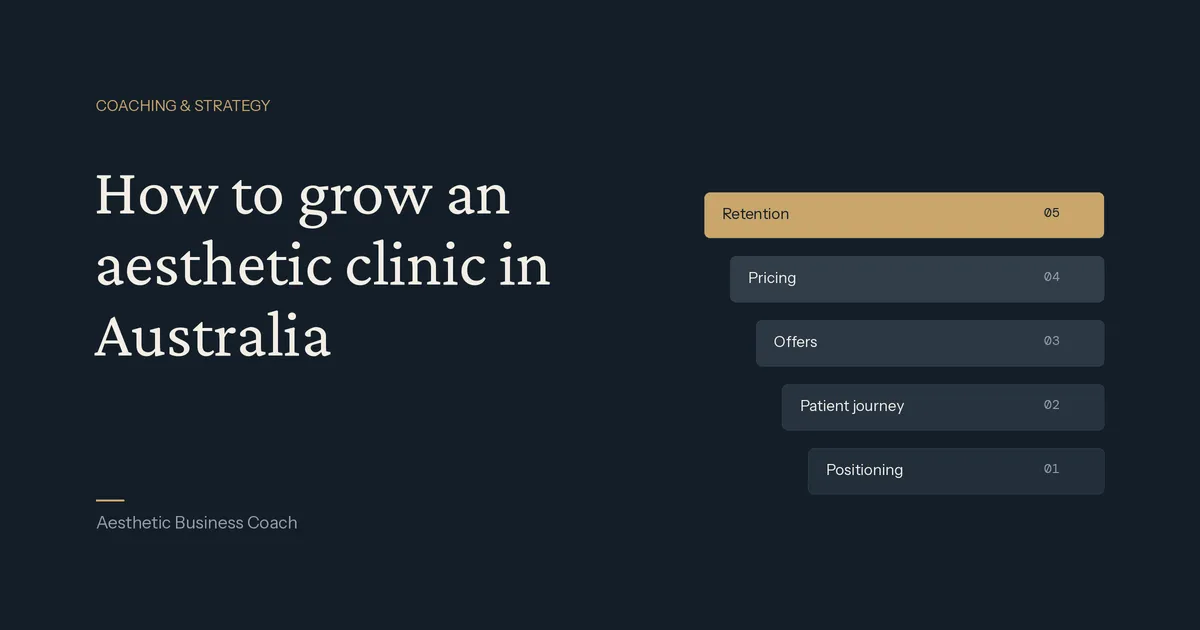
How to Grow an Aesthetic Clinic in Australia: The Owner's Guide
If you’re searching for how to grow an aesthetic clinic, you’re probably already good at the work. Your results are strong, patients come back, and word of mouth has carried you a long way. The ceiling you’ve hit sits somewhere else: in the enquiries that go quiet, the follow up that depends on who’s free, the price list that hasn’t moved in three years. I’ve owned clinics in the UK for more than a decade and coached owners in Australia for seven years, and the pattern repeats. This guide is the order I’d fix things in.
Why do good aesthetic clinics stop growing?
Clinics stall for systems reasons. The treatments are excellent, so the owner assumes the problem must be marketing and buys more of it. Meanwhile enquiries sit unanswered, consultations end without a plan, and lapsed patients are never invited back. More traffic through a leaking process produces more leaks, at a higher cost per patient.
A story from a discovery call, details changed. She’d booked, nearly cancelled twice, and started talking before I’d finished saying hello. The follow up leaked, she said. Enquiries came in through the website and sat in an inbox two people half checked. Her show rate was bad and she’d never measured it because she didn’t want to see the number. Her best practitioner was drowning in admin. She had a folder of ideas for fixing all of it, and the folder was two years old.
Then she stopped and said, why am I telling you this, you were going to ask me questions.
I hadn’t asked one. She’d done the whole diagnosis in four minutes, unprompted, and it was correct.
After seven years of these calls I’d bet the business on this pattern. By the time an owner books, they already know what’s wrong. I have never once told an owner something about their clinic that surprised them. The knowing is never the missing piece. What’s missing is a plan that turns a two year old folder into a first step for Monday, and the confidence that it’s fixable, in order, by people who’ve fixed it before.
So this guide is that order.
What are the five foundations of a clinic that grows?
Positioning, patient journey, offers, pricing and retention. They’re listed in that sequence because each one depends on the one before it. A clear position makes offers easier to write. Good offers only convert when the patient journey delivers them. Pricing holds when the patient experience earns it. Retention is what the other four produce when they’re right.
Positioning
Positioning is the answer to a question a patient asks silently before they ring: why this clinic and not the one two suburbs over? If the honest answer is “we do the same treatments for a similar price”, you’ve got no position, and you’ll be compared on price forever. The clinics that grow can finish this sentence in one breath: we’re the clinic for people who want a particular outcome and are prepared to do it properly. It shapes who you attract, and it’s the reason a patient waits an extra week to see you specifically.
Patient journey
The patient journey is everything that happens from the moment someone finds you to the moment they rebook. Enquiry, first reply, consultation, treatment, aftercare, follow up, rebooking. Most owners can describe the treatment step in detail and have never mapped the rest. Walk it yourself. Ring your own clinic as a stranger. Fill in your own web form at 9pm. You’ll find the gaps within an hour.
Offers
An offer is a treatment plan with a reason to say yes. A single session is a transaction. A plan of three sessions with a review, aftercare and a clear outcome is an offer, and it changes the conversation from “how much is one?” to “what would you recommend?”. Offers built around a concern and a plan also sit far more comfortably inside advertising rules than product-led promotions, which matters in this industry.
Pricing
Pricing is the growth lever that needs no extra patients, no extra hours and no extra spend. It’s also the one owners fear most, because it feels personal. If your prices haven’t moved while product, rent, wages and insurance have, you’ve been giving yourself a pay cut every year. Raising prices properly (told personally, in advance, with an honest reason, mid course patients honoured) is covered later in this guide and in the pricing session of every coaching plan.
Retention
Retention is the cheapest growth there is. The patient you already have costs nothing to acquire, already trusts you, and will refer if you make it easy. Memberships, treatment plans, reactivation campaigns for anyone who hasn’t visited in six months, and a weekly review request rhythm. Every clinic I’ve coached had lapsed patients worth more than a quarter of ad spend sitting in the database, untouched.
How do you stop enquiries leaking before they book?
Reply in minutes, follow up more than once, and run consultations that end with a plan. Most clinics lose more revenue between the enquiry and the booking than anywhere else in the business. The fixes cost far less than advertising, because you’re recovering demand you already paid for.
Start with reply speed. A 2011 study published in the Harvard Business Review audited 2,241 US companies with a test web enquiry. Only 37% replied within an hour. The average response time among those who replied at all was 42 hours, and 23% never replied. That study was American and mostly not about clinics, so treat the exact numbers with care. The shape of the finding matches what I see in Australian clinics every week: the biggest gap isn’t clinics replying slowly, it’s enquiries that never get a reply.
Then follow up. In every clinic I’ve measured, most patients needed more than one contact before they booked, and most clinics stopped after one. The enquiry that went quiet on Tuesday is often still interested on Friday. A short, warm second and third message, sent automatically, recovers a surprising share of them.
Then the consultation. The most common leak in the whole process is a consult that ends with “have a think and let us know”. A consultation should end with a recommended plan, a price for that plan, and a date. If the patient wants to think, agree when you’ll speak again and put it in the diary before they leave.
If you want the mechanics of the first reply, the speed to lead post publishing later this week covers it step by step.
Which numbers should a clinic owner check every week?
Six numbers, ten minutes, every Monday. Enquiries, enquiry to consultation rate, consultation to booking rate, show rate, average patient value and rebooking rate. If you only track revenue, you’ll only find out something’s wrong when it’s already cost you a quarter.
Here’s what each one tells you.
- Enquiries this week, by source. Tells you whether marketing is working at all.
- Enquiry to consultation rate. Tells you whether the front desk and follow up are working.
- Consultation to booking rate. Tells you whether consults are ending with a plan.
- Show rate. Tells you whether reminders, deposits and the booking experience are doing their job.
- Average patient value over twelve months. Tells you what you can afford to spend to win a patient.
- Rebooking rate. Tells you whether retention is happening or being left to chance.
Write them on one page. When one moves, you’ll know which part of the clinic to look at. Most owners I meet have never seen these six side by side, and the first time they do, the decision about what to fix first makes itself.
Should you spend on marketing or systems first?
Systems first, always. Marketing is fuel, and fuel poured into a leaking tank runs out faster. Get reply speed, follow up and consultation structure working, then add spend. Clinics that do it the other way round conclude that marketing doesn’t work, when what didn’t work was the twelve hours between the enquiry and the reply.
I wrote about this in Systems Change Everything, and it’s the reason we built ClinicOS rather than just running ads for clinics. The order matters because it protects the money. A clinic with a 20% enquiry to booking rate that doubles its ad spend gets twice the enquiries and twice the waste. A clinic that lifts that rate to 40% first gets the same result for the money it’s already spending.
You’re ready to add spend when the six weekly numbers have been stable for a month and you can say, without guessing, what a new patient costs and what they’re worth. At that point marketing stops being a gamble and becomes a purchase.
How does an independent clinic compete with the chains?
By refusing to play their game. The chains run on advantages you don’t have: bulk purchasing, brand budgets, interchangeable staff. They also carry weaknesses you don’t share: no local soul, high staff churn, patients as ticket numbers. Copying their playbook imports every weakness and none of the strengths.
A large corporate chain opened in the same city as one of my UK clinics. Glossy campaigns on every bus, aggressive pricing, treatment rooms lined up like a car wash. An owner I knew well, a genuinely skilled practitioner with patients who waited an extra week to see her, decided to copy them. She cut prices, ran high volume promotions, shortened appointments and hired two juniors. Six months in she was busier than ever and more miserable than I’d seen her. The numbers were up and the margins were gone, because she had the chain’s prices without the chain’s buying power. Her regulars felt processed, and several left. For the chain.
It took most of a year to unwind. Prices back up, with a proper explanation. Consultations back in her own hands. Appointments back to a length where care was possible. She matched the chain only where systems matter (reply speed, easy booking, professional follow up) and beat it everywhere humanity matters, which turned out to be everywhere else. The chain is still there. So is she. Her car park is full on Tuesdays.
Learn from anyone. Copy no one whose advantages you don’t share.
How to grow an aesthetic clinic in 90 days
Thirty days of measuring and fixing leaks, thirty days of building the consultation and retention engine, thirty days of adding marketing on top of a process that now converts. Written on one page, pinned somewhere you’ll see it, reviewed every Monday with the six numbers.
Days 1 to 30: find the leaks
Ring and message your own clinic as a stranger. Pull the six numbers for the last three months. Write your first reply, second and third follow up messages and switch on the automation. Read your price list against your costs and decide what moves and when.
Days 31 to 60: build the engine
Write a one page consultation framework and use it in every consult. Build a treatment plan offer for your two most common concerns. Send one reactivation campaign to everyone who hasn’t visited in six months. Ask every happy patient for a review, on a fixed day each week.
Days 61 to 90: add fuel
Now marketing. Fix your Google Business Profile. Start one paid channel with a modest budget, tracked to booked consultations rather than clicks. Plan the next month of content in one afternoon. Compare cost to win a patient against average patient value and decide whether to scale.
By day 90 you’ll know your numbers, your process will convert, and the next decision about spend will be a calculation instead of a hope.
When should a clinic owner get help?
When you’ve known what’s wrong for more than a few months and it still isn’t fixed. Knowing isn’t the bottleneck. Time, order and someone who’s done it before are. The right help turns a folder of ideas into a sequence, and gives you a Monday task instead of a Sunday night worry.
I knew for at least eighteen months that my UK clinic only worked while I was personally holding it up. I knew it on the couch answering enquiries at ten at night. Knowing changed nothing. What changed things was one conversation with someone who said, calmly, that it didn’t have to be that way, and then pointed at the first step.
If you’re not sure where you sit, the clinic growth quiz takes four minutes and scores you across the five foundations. If you’d rather talk it through, that’s what coaching is for. Either way, the only expensive option is another year of knowing.
Frequently asked questions
How long does it take to grow an aesthetic clinic?
Leaks in follow up and consultations can be fixed inside 30 days, and you’ll see it in bookings within the same quarter. Positioning, pricing and retention compound over six to twelve months. Owners who expect a marketing campaign to change the business in a fortnight usually stop too early. Owners who fix the process first see steady, compounding growth.
Do I need a big marketing budget to grow my clinic?
No. The first gains come from enquiries you already receive, patients you already have and prices you already charge. Reply faster, follow up properly, run structured consultations and reactivate lapsed patients before spending a dollar more on ads. Once those convert, a modest ad budget goes much further because less of it is wasted.
What is a good consultation conversion rate for an aesthetic clinic?
Measure yours before worrying about anyone else’s. In my experience, clinics that have never used a consultation framework convert well under half their consultations into booked plans, and a structured consult that ends with a recommendation, a price and a date moves that number materially within a few weeks. Track it weekly and compare against your own baseline.
Should I raise my prices to grow?
If your prices haven’t moved in two or more years while your costs have, yes. Patients rarely leave over a fair rise explained honestly by someone they trust. Tell existing patients personally and in advance, give a real reason, set a live date and honour anyone mid course at the old rate. Revenue rises with no extra patients or hours.
What is the fastest way to get more bookings without more ad spend?
Three places, in order. Reply to every enquiry within minutes, including after hours, with an automated first message. Send a reactivation campaign to every patient who hasn’t visited in six months. Add a waitlist so cancelled slots are refilled automatically. All three recover demand you’ve already paid for.
What does an aesthetic business coach do that a marketing agency doesn’t?
An agency runs a channel. A coach works on the whole business: positioning, pricing, patient journey, team and numbers, then decides which channels deserve budget. I’m a clinic owner as well as a coach, so the advice comes from having run the diary, the front desk and the ad account myself.
Book a free 45 minute discovery call
Bring your last three months of enquiries, bookings and revenue. We’ll put the six numbers side by side and work out which of the five foundations to fix first. No pitch, and you’ll leave with a first step for Monday. Book your discovery call here.