

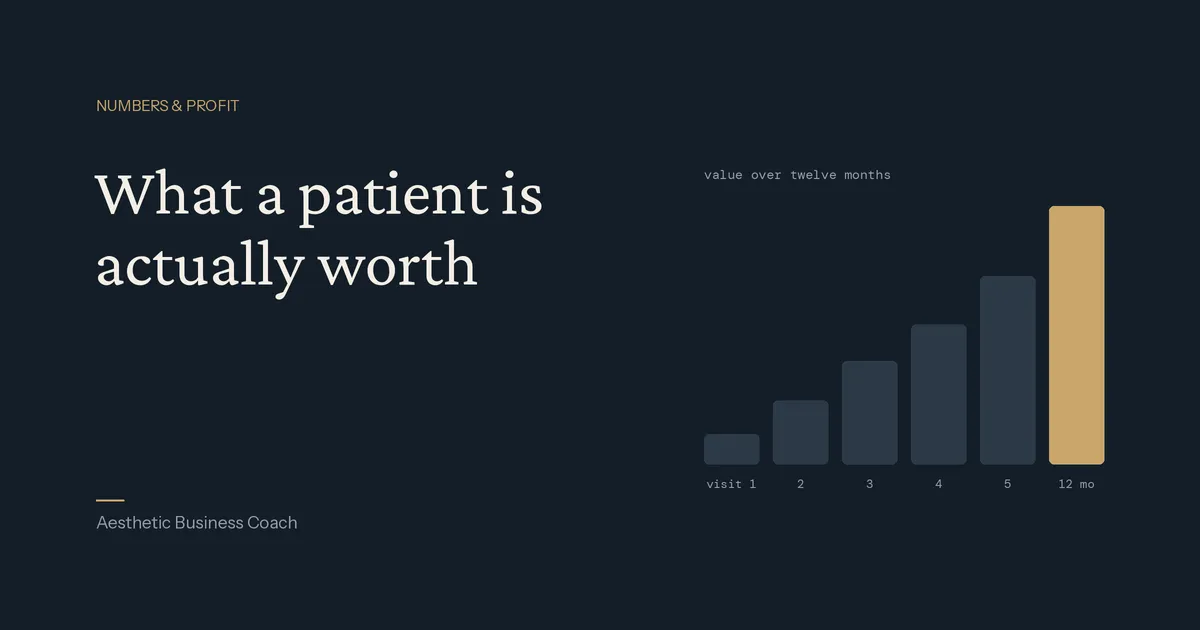
Patient Lifetime Value: What an Aesthetic Patient Is Worth
An owner tells me her ads are too expensive. I ask what a patient is worth, and she tells me the price of a treatment. That’s where the conversation usually goes wrong, because patient lifetime value and the price of one appointment are completely different numbers, and most clinics run their marketing as if they were the same. This post is how to work out the real figure, why it’s nearly always many times larger than the one in your head, and what it changes once you’ve seen it.
Why is the price of a treatment the wrong number?
Because a patient who has a good first visit comes back, keeps coming back for years, and refers people. The first appointment is the opening of a relationship. Judging your marketing against one appointment’s revenue is like judging a lease against the first week’s rent.
The mistake is understandable. The treatment price is the number you see on the day. The rest of the relationship is spread across years and never shows up as one figure anywhere in the clinic. So owners look at a lead that cost money to acquire, compare it against the first treatment, and conclude the marketing doesn’t add up. Sometimes it doesn’t. Usually the maths was just done on the wrong number.
There’s a second reason the treatment price misleads. It makes every patient look the same. In reality the patient who comes for a single session and never returns and the patient who visits five times a year for six years have almost nothing in common, and a clinic that treats them identically at the front desk will keep getting the first kind.
How do you calculate patient lifetime value?
Take a normal patient, work out what they spend on a first visit, how often they return in a year and what they spend when they do, how many years they stay, and multiply. Then add something for the people they refer, conservatively. Rough is fine. Honest is essential.
Here’s the shape of it, with numbers that are only an illustration.
First visit spend: say $350.
Return visits in a year after the first: say three, at $300 each. That’s $900.
Years they stay: say three. First year is $1,250, the next two are $900 each, so $3,050.
Referrals: say one in four patients refers one person who becomes a patient. That’s a quarter of another $3,050, roughly $760.
Lifetime value: around $3,800.
An owner who thought a patient was worth $350 was off by more than ten times. That’s typical. The exact multiple varies by clinic, but the direction never does.
Two rules for doing it honestly. Use your real return rates, pulled from your booking system, rather than the ones you hope for. If a third of your first visit patients never come back, the maths has to include them, which is why you use a normal patient rather than your best one. Keep the referral allowance conservative. Referrals are real in this industry, but they’re the easiest number to inflate.
If your booking system can’t tell you how often patients return, that’s the first thing to fix, and the growth guide covers the six numbers to track weekly.
What changes once you know the number?
Everything downstream of it. How you feel about cost per lead, what you’re willing to spend on the first visit experience, how you value the person on the front desk, and how it lands when a patient quietly drifts away. The number turns four things you’d been treating as details into the biggest levers in the clinic.
It changes how you see a lead that costs money. You’re no longer comparing that cost against one appointment. If a patient is worth thousands over three years, the question about a lead that costs a hundred dollars isn’t whether it’s expensive. It’s whether your process converts it, which is a different problem with a different fix.
It changes what you spend on the first visit. The first visit decides whether the years happen. The welcome, the time in the consultation, the aftercare message that evening, the follow up a week later. Those are the purchase price of the next three years.
It changes how you think about the front desk. The person who converts an enquiry isn’t booking an appointment. They’re opening a relationship worth many multiples of it. That reframes how much time they should have for the call, and why a rushed forty second price quote is the most expensive thing that happens in the clinic all day. The price enquiry script exists for exactly this reason.
It changes how it feels when a patient drifts. A patient who came once and never returned isn’t a quiet month. They’re the loss of nearly everything they were worth.
Why does keeping a patient beat winning a new one?
Because keeping an existing patient for one more year is often worth more than winning a new one, and it costs a fraction as much. They already know you, already trust you, and don’t need to be found, convinced or converted. Retention is the cheapest growth in the clinic and the one most owners spend the least on.
Most owners chase new patients because new patients feel like growth. The arithmetic says something less obvious. Look at the example above: a patient’s second and third years were worth $1,800, more than half of the total. A reactivation message to someone who hasn’t visited in six months costs almost nothing to send. A treatment plan that maps out the next twelve months at the first visit costs a few minutes of the consultation. A membership that turns an occasional visitor into a regular costs some thought about pricing. All three protect the years, and the years are where the value is.
This is why I’d fix retention before spending more on acquisition. New patients through a clinic that loses a third of them after one visit is expensive growth. The same new patients through a clinic that keeps them is compounding.
Two warnings before you use the number
Don’t use lifetime value to justify unlimited ad spend, because it’s a lifetime figure and your bank account works in months. Don’t work it out with your hopeful numbers. Cash flow and worth are different questions, and a clinic that confuses them can be worth a lot on paper and broke by Christmas.
The first warning matters most for owners who’ve just seen the number for the first time. It’s tempting to conclude that if a patient is worth $3,800, a lead costing $150 is cheap, so spend more. But the $3,800 arrives over three years and the $150 leaves this month. You can afford to spend on acquisition up to the point where cash flow still works, not up to the point where lifetime value still works. Those are different lines, and the second one is a long way past the first.
The second warning is about honesty. If you assume every patient returns four times a year and stays five years, you’ll get a number that flatters you and a marketing budget that ruins you. Pull the real figures. If they’re worse than you’d like, that tells you where the work is.
Where should you put the number?
Somewhere you’ll see it. On the wall, on the dashboard your team looks at, in the front desk script. When an enquiry goes unanswered for two days, that’s not a lost appointment. When a patient drifts after one visit, that’s not a quiet month. When your receptionist is too rushed to have a proper conversation, that’s not a staffing detail.
Most clinics behave as though patients are worth one appointment, and then wonder why the marketing maths never quite works. The number is the fix. It’s the same number we put at the centre of the numbers session in every coaching plan (details on the pricing page), and the reason ClinicOS reports on revenue per patient over time rather than revenue per treatment.
Frequently asked questions
What is patient lifetime value for an aesthetic clinic?
The total revenue a typical patient brings to the clinic across the whole relationship, from the first visit to the last, plus a conservative share of the patients they refer. It’s calculated from first visit spend, return visits per year, spend per return visit, and years retained. For most clinics it’s many times the price of a single treatment.
How do I find my clinic’s real return rate?
From your booking or CRM system, not from memory. Take every new patient from two years ago and count how many returned within twelve months, how many times, and what they spent. That gives you a real first year figure. Do the same for the year after to see how many stayed. If your system can’t produce this, that’s a gap worth closing first.
Should I include referrals in patient lifetime value?
Yes, but conservatively. Referrals are real in aesthetics and leaving them out understates the value of a happy patient. A safe approach is to assume a modest share of patients refer one person each, and count only the referred person’s first year. Inflating the referral allowance is the easiest way to end up with a number that flatters you.
How much should I spend to acquire a patient?
Less than cash flow allows and well below lifetime value. Lifetime value tells you the ceiling on what a patient is worth over years. Cash flow tells you what you can afford this month. Set your target cost to win a patient from the second figure, then compare it against the first to confirm the marketing makes sense over time.
Why does my marketing feel expensive if patients are worth so much?
Usually because the process between enquiry and booking is losing most of the patients before the lifetime value ever has a chance to arrive. Reply speed, follow up and consultation structure decide what share of enquiries become patients. Fix those first and the same ad spend produces a completely different return.
Is it better to spend on new patients or on keeping existing ones?
Keeping existing ones, until retention is working. An existing patient costs almost nothing to bring back and is already past the expensive part of the relationship. Reactivation messages, treatment plans and memberships protect the years where most of the value sits. Add acquisition spend once the clinic is keeping the patients it wins.
Book a free 45 minute discovery call
Bring a rough idea of first visit spend, how often patients return and how long they stay. We’ll work out your real patient value on the call, compare it against what you’re paying to win a patient, and see where the process is leaking. Book your discovery call here.