

How Much Is It? How to Answer Price Enquiries Without Losing the Patient
If you’re wondering how to answer price enquiries, you’ve noticed the pattern. Someone rings, asks the price of a treatment, says thanks very much, and hangs up. The call was polite, prompt and accurate, and the person is gone forever. I trained my own team to do exactly that for years. This post is the script that fixed it, why your front desk struggles to use it, and how to train it in an afternoon.
Why is a number the wrong answer to “how much is it?”
Because somebody ringing to ask a price is trying to work out whether you’re the right place, and price is the only question they know how to ask. It’s a conversational door handle. Answering with a number and nothing else is like a patient saying “my shoulder hurts” and a clinician replying “yes, that happens”.
For years our front desk handled price calls well, by the standard we’d set. Polite, prompt, accurate. The caller said thanks, hung up, and we ticked the box. What we never noticed was that we’d learned nothing about them, they’d learned nothing about us beyond a figure, and they now had a number to compare against the next clinic they rang. We’d turned ourselves into a line on their spreadsheet.
The number has to be given. Dodging it destroys trust faster than any figure could. But the number on its own tells the caller nothing about what they’d get, who they’d see, or whether the treatment is even right for them. A price with no context invites comparison shopping, and on price alone there’s always someone cheaper.
What are the three moves for answering a price enquiry?
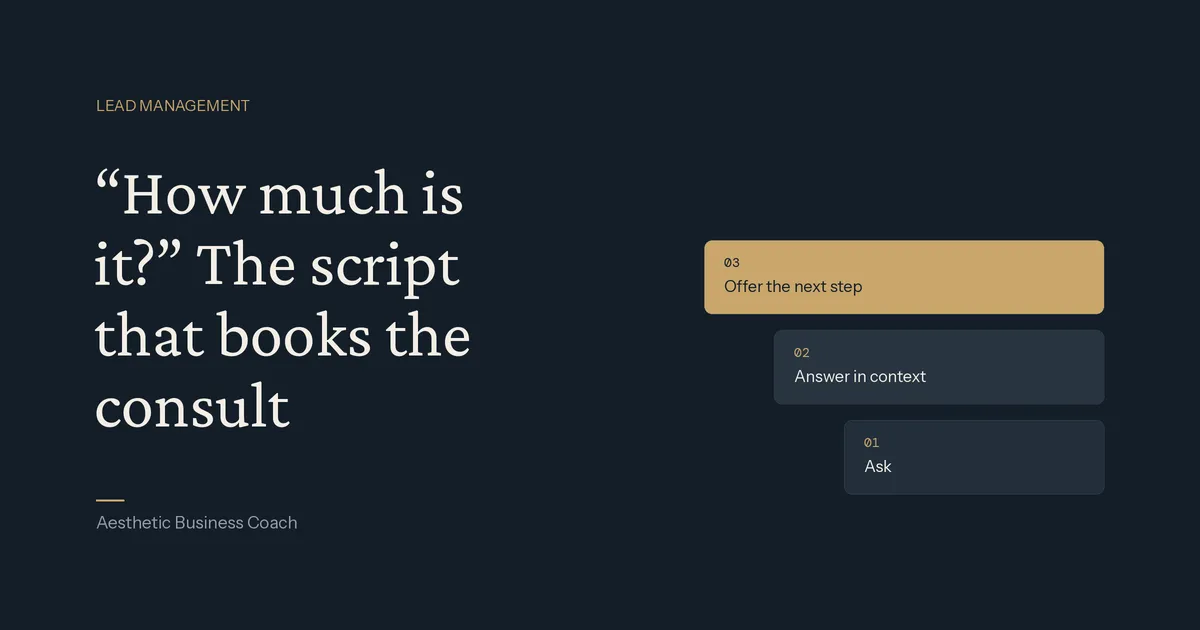
Acknowledge and ask what they’re hoping to improve. Answer the price honestly, in the context of what it involves and what it depends on. Offer the next step, every time, so the call ends with a consultation booked, a time to talk again, or a name and number in the system. Never with “thanks anyway” and a dial tone.
Move one: acknowledge and ask
“Happy to talk you through that. Can I ask what you’re hoping to improve?”
Nearly everyone answers, because they want to be asked. The question turns a quote into a conversation. It also tells you, within twenty seconds, whether the treatment they’ve named is actually the treatment they need, which it often isn’t. A caller asking about one treatment because it’s the only name they know is common, and the honest answer is usually “that might be right, or there may be a better option, and a consultation is how we’d work that out”.
Move two: answer honestly, in context
Give the range and immediately put it next to what it involves and what it depends on. “For that concern, treatment usually sits between [your range], and where you’d land depends on the area, how many sessions you’d need and what the practitioner recommends after seeing you. A consultation covers all of that.”
Never dodge the price. Never say “it depends” and stop there. Never make them ask twice. The range with context is the honest answer, and honesty is what makes the next move possible.
Move three: offer the next step
“The best way to get an accurate answer is a consultation with [practitioner]. She’s got Tuesday afternoon or Thursday morning this week. Which suits?”
Two options, both specific. If they’re not ready, agree a time to talk again and put it in the diary. If they won’t do that, take a name and a mobile number so a follow up message can go out tomorrow. One of those three outcomes, on every call.
We ran that script for a month in my UK clinic and our phone enquiries converted at more than double the previous rate. Same treatments, same prices, same team. We’d stopped answering a question and started having a conversation.
How to answer price enquiries: the script, word for word
Write the three moves on one page, then agree the exact wording for the three most common questions your desk gets. Keep it in plain speech, the way your best receptionist already talks. A script that reads like a script fails on the second call.
Below is how the moves sound for the most common call types. Adapt the words, keep the structure.
For a device treatment where you can quote publicly:
- Ask: “Happy to help. What’s prompted you to look into it?”
- Answer: “A single session is [price including GST], and most people need a course, so [practitioner] would map that out at the consultation and give you the full cost before anything’s booked.”
- Next step: “Consultations are complimentary and take about half an hour. I’ve got Wednesday at 2 or Friday at 10.”
For a prescription-only treatment, where the brand and the specifics belong in the consultation:
- Ask: “Of course. Can I ask what you’re hoping to change?”
- Answer: “Pricing for that depends on what the practitioner recommends once she’s assessed you, so I’d be guessing if I gave you a number now. What I can tell you is what a consultation covers and what it costs.”
- Next step: “The consultation is [price or complimentary], and it’s where you’d get an exact quote. Tuesday or Thursday?”
For the caller who’s clearly comparing clinics:
- Ask: “No problem. Have you had this treatment before, or is this the first time you’re looking into it?”
- Answer: “Prices across clinics vary a lot because the practitioner, the product and the time in the appointment vary a lot. Ours is [range], and here’s what’s included.”
- Next step: “If you’d like to meet the practitioner before deciding, the consultation is the easiest way to compare properly.”
Why does the front desk struggle to use it?
Because the desk is the worst place in the clinic to have a patient conversation. Your receptionist is mid task, with someone standing in front of them, when the phone rings. A proper conversation takes longer than a number, and the environment punishes anything that takes longer. The script is fine. The setting makes it impossible.
I watched this happen in my own reception. In ninety seconds my receptionist was interrupted three times: a patient at the desk to pay, a practitioner asking where something was kept, a card machine beeping. She handled all of it. The phone call ended in forty seconds with a price and a thank you.
Two fixes. Take the admin off the desk so the phone gets a fair share of attention. And give the desk a protected window each day, phones to voicemail with a promised call back within the hour, purely for finishing conversations that convert. The speed to lead post covers the whole setup, including how a missed call becomes a text within seconds so the caller isn’t lost while the desk is busy.
The second reason the script fails is simpler. Nobody ever trained it, because most owners have never written it down. Your best receptionist is running some version of it from instinct. Your newest one is reading out the price list.
How do you handle price questions by text, chat and email?
Same three moves, shorter. Acknowledge, ask one question, give the honest range with one line of context, offer a specific next step. Written replies have one advantage over the phone: the patient can answer at 9pm from the couch, and the conversation is still open in the morning.
A text reply that works:
“Hi Emma, thanks for asking. Happy to talk you through pricing. Can I ask what you’re hoping to improve? That’ll help me give you a proper answer rather than a guess. [Name], [clinic]”
Then, once they’ve replied:
“Thanks, that helps. For that, treatment usually sits between [range], depending on the area and how many sessions you’d need. [Practitioner] can give you an exact plan at a consultation. Would Tuesday afternoon or Thursday morning suit?”
Two rules for written replies. Keep prescription-only treatment specifics out of anything templated, because a template sent to many people can count as advertising even when a single reply doesn’t. And make sure the reply goes out within minutes, because a written price question left overnight is answered by whichever clinic replied first.
How do you train it in an afternoon?
Write the three moves on one page. Agree the wording for your three most common questions. Role play each one twice. Then listen, kindly, to how it’s actually used for a fortnight, and measure phone enquiry to consultation rate before and after.
The whole thing takes an afternoon because the script is short and your team already knows the treatments. What they’ve been missing is permission to have a conversation instead of a transaction, and a structure to hang it on.
Measure it. Count phone enquiries for two weeks before and two weeks after, and count how many became consultations. That single ratio is worth more than most marketing reports, and it’s the number that tells you whether the afternoon paid for itself. In every clinic I’ve done this with, it did.
The people ringing you are the warmest leads you will ever get. They found you, chose you, and picked up a phone, which almost nobody does anymore. Give them more than a number.
Frequently asked questions
Should I put prices on my clinic website?
For device treatments and consultations, yes. Patients trust clinics that are open about cost, and any price shown must be the total including GST and unavoidable fees. For prescription-only treatments, pricing belongs in the consultation, because publishing it can count as advertising a Schedule 4 medicine. A “from” price with a clear explanation of what determines the final cost is usually the honest middle ground for device treatments.
What if the caller only wants the price and refuses to answer questions?
Give it. Clearly, honestly, in one sentence, with one line of context. Then offer the next step anyway. Some callers genuinely are price shopping, and the range with context still does more for you than a bare number. A caller who refuses to engage at all was unlikely to book anywhere on that call, so the cost of trying is nothing.
How do I answer when our price is higher than the clinic down the road?
Say so, without apology, and explain what the difference buys. Practitioner experience, time in the appointment, the product used, the aftercare. Then offer the consultation as the way to compare properly. Patients rarely choose a clinic on price alone once they’ve met the practitioner, which is why the goal of the call is the consultation rather than winning the price comparison.
Should the receptionist quote prices for injectable treatments?
Only in a one on one conversation, and only as a range that depends on the practitioner’s assessment. Never in a templated message, on the website or in a social post. The brand and the exact quote belong in the consultation. That’s also better for the patient, because the right treatment can’t be decided over the phone.
How long should a price enquiry call take?
Long enough to ask one question and offer one next step. Two to four minutes is typical once the script is familiar. If calls are consistently ending in under a minute, the desk is too busy to have the conversation, and the fix is the environment rather than the person.
What do we do with callers who don’t book on the call?
Take a name and mobile number and put them in the pipeline with a follow up message scheduled for the next day. Most people need more than one contact before they book. A short, warm text the day after the call recovers a real share of them, and none of it needs the receptionist to remember.
Book a free 45 minute discovery call
Bring a rough count of last month’s phone enquiries and how many became consultations. If the ratio is lower than you’d like, we’ll write your one page script on the call and map the setup that catches the calls your desk can’t. Book your discovery call here.