
AHPRA Advertising Guidelines for Cosmetic Clinics, Explained in Plain English
Most clinic owners I meet have one of two relationships with the AHPRA advertising guidelines. They ignore them and hope, or they’re so frightened of them that they’ve stopped marketing altogether. Neither works. The rules are stricter than most owners think and clearer than most owners fear. This is the plain English version, written by a clinic owner rather than a lawyer, so run anything public past your own advisor before it goes live. Read this once and the cold flush every time you hit publish should go away.
Who do the AHPRA advertising rules apply to?
Anyone who advertises a regulated health service. That includes registered practitioners, the clinics that employ them, the non-practitioner owner who runs the Instagram account, and the agency that writes the ads. Section 133 of the National Law refers to “a person”, and AHPRA has been clear that liability can sit with more than one person at once.
This surprises owners who aren’t nurses or doctors themselves. If your clinic offers a treatment performed by a registered practitioner, the advertising for that treatment is advertising a regulated health service, and the rules apply to whoever published it. Handing your marketing to an agency doesn’t move the responsibility. It just adds another name to the list.
The practical upshot is that your compliance can’t live in the practitioner’s head. It has to live in a written checklist that whoever hits publish has read. Most breaches I’ve seen weren’t reckless. They were a receptionist reposting a nice comment, or a supplier template used without anyone checking it.
What does section 133 actually ban?
Five things. Advertising a regulated health service must not be false, misleading or deceptive. It must not offer a gift, discount or inducement without stating the terms. It must not use testimonials about the clinical service. It must not create an unreasonable expectation of beneficial treatment. And it must not encourage indiscriminate or unnecessary use of health services.
Here’s what each one looks like in a real clinic.
False, misleading or deceptive
This covers the obvious lie and the quiet implication. Calling a treatment “clinically proven” without a study you can name. Describing a nurse as a “specialist” when specialist is a protected title. Using “expert” or “leading” without anything behind it. Implying a treatment is suitable for everyone. Leaving out the fact that results vary or that a course is usually needed. Misleading by omission counts as misleading.
Inducements without terms
You can offer a discount, a package or a free consultation. What you can’t do is offer it without the terms and conditions stated in the same advertisement. “20% off this month” needs to say which treatments, for whom, until when, and any exclusions. Under Australian Consumer Law the price shown also has to be the total including GST and any unavoidable fees.
Testimonials
The one that catches the most clinics. You cannot use a testimonial about the clinical care in your own advertising. A patient quote on your website. A screenshot of a review on Instagram. Reposting a story where someone thanks you for their treatment. Liking or sharing a comment about their results. All of those are your advertising, and all of them breach the rule.
Unreasonable expectation of benefit
Anything that suggests a result that a reasonable patient couldn’t expect. “Permanent.” “Guaranteed.” “Look ten years younger.” Before and after images chosen because they were the best result you’ve ever had. Language that sells a transformation rather than a treatment.
Encouraging indiscriminate or unnecessary use
Urgency and pressure. “Book now, spots running out.” Countdown timers on a treatment. “Treat yourself” framing on a prescription procedure. Anything that pushes someone toward a health service they may not need, or faster than they’d otherwise decide.
What changed on 2 September 2025?
AHPRA and the National Boards brought in specific guidelines for advertising higher risk non-surgical cosmetic procedures. That means cosmetic injectables, fat dissolving injections, thread lifts, PRP, dental veneers and similar. The new rules sit on top of section 133 and tighten it in ways that changed most clinics’ Instagram overnight.
The AHPRA guidelines run to a short document and you should read the current version yourself. The parts that matter most to a clinic’s day to day marketing:
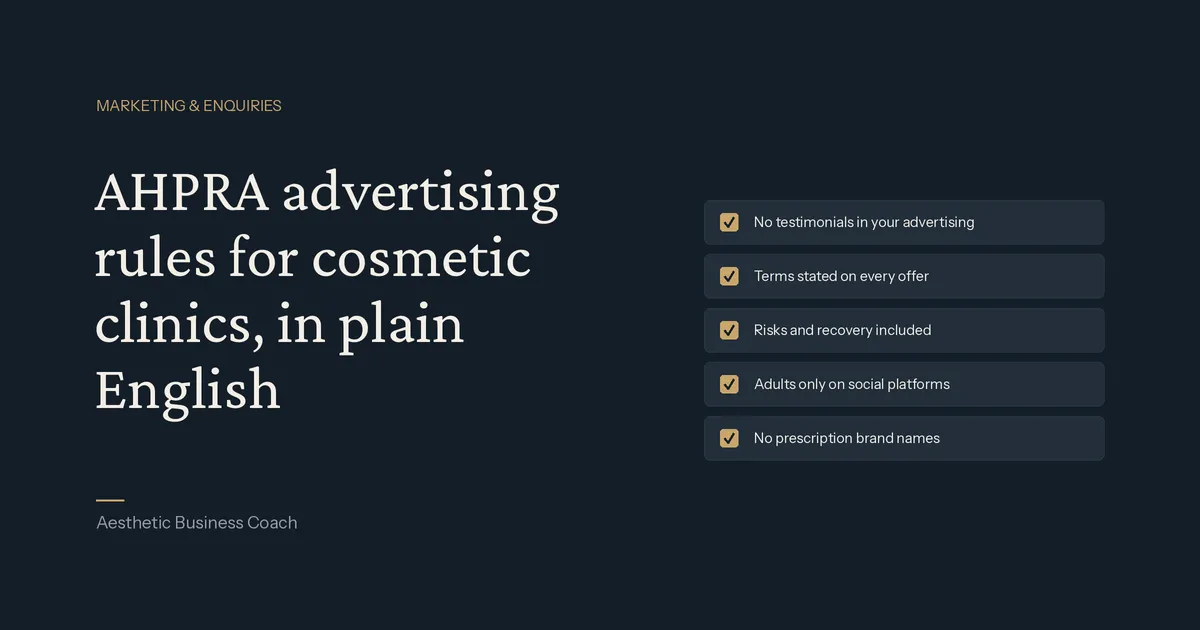
- Advertising for higher risk cosmetic procedures must not target anyone under 18. On social platforms that means restricting it to adult audiences and marking it accordingly.
- Influencer and patient testimonials are out, which extends the section 133 rule to paid and gifted promotion.
- Words like “safe”, “painless”, “no downtime” and phrases that link the procedure to self esteem or happiness are out.
- Filters, apps or tools that predict or simulate a post-procedure appearance can’t be used.
- Advertising needs to include information about risks and recovery rather than glossing over them, and the practitioner’s registration details should be findable.
- Content must not trivialise the procedure. Treating a prescription injectable like a beauty product, a lunchtime treat or a party add-on is the kind of framing AHPRA has named.
The tone of the guidelines is the tell. AHPRA describes the aim as putting patient safety over profit, and the enforcement has followed. Between September 2022 and March 2025 the regulator investigated roughly 360 notifications about non-surgical cosmetic procedures. That was before the new rules gave it more to work with.
Can you still ask for Google reviews?
Yes. The testimonial rule is about what you use in your advertising, and a review a patient leaves on a platform you don’t control isn’t your advertising. Asking patients to leave a review is fine. What you can’t do is bring those reviews back into your marketing, or interact with them in a way that turns them into an endorsement.
So the line looks like this. A review sits on your Google profile: fine. You send a text after treatment asking for a review with a link: fine, as long as nothing’s offered in exchange. You screenshot the review and post it to Instagram: breach. You reply to the review saying “so glad you love your results”: treading close, because you’ve now amplified a testimonial about the clinical service. You like and share a patient’s own post about their treatment: breach under the 2025 guidelines.
Keep the reviews where they live. They do their job there, and a steady stream of recent ones does more for a local clinic than any repost would.
Can you offer discounts, packages and free consultations?
Yes, with the terms stated in the same advertisement and without pushing anyone toward treatment they don’t need. A free consultation is an inducement, so say what it includes. A package price needs the total cost, what’s in it, and what happens if the practitioner recommends something else. A discount needs a genuine prior price and an end date.
Where clinics get into trouble is stacking urgency on top. A discount is allowed. A discount with a countdown timer and “only 4 spots left” is encouraging indiscriminate use, and if the four spots aren’t real it’s misleading conduct under consumer law as well. The Black Friday post later this year covers how to run a promotion that adds value without either problem.
For prescription-only treatments there’s a further layer. The TGA doesn’t allow prescription medicines to be advertised to the public, so a discount on a branded injectable is two breaches in one line. Promote the consultation instead.
What about before and after photos?
Before and after images are advertising and carry their own conditions. They must be your own patients, with consent, taken in consistent lighting and angles, unedited, and representative rather than your best ever result. Under the 2025 guidelines they also can’t be shown to under-18s, and they can’t be used in a way that creates an unreasonable expectation.
My honest advice to most clinics is to treat before and afters as a consultation room tool rather than a marketing one. Shown to a patient one on one, with the practitioner explaining what’s realistic for them, they’re useful. Posted publicly, they’re a compliance risk with modest marketing value, because every clinic posts them and patients have learned to discount them.
Where do the TGA rules overlap?
The TGA regulates therapeutic goods, and prescription-only medicines are the overlap that matters. You can’t name an injectable brand in public advertising. You can’t imply a therapeutic good is safe or without side effects. Practitioners can’t endorse a therapeutic good in advertising. Registered devices can be named and priced, which is why they carry the direct response weight.
The practical rule: “anti-wrinkle injections” and “dermal filler” in public, brand names in the consultation. If you see a competitor naming brands on their website with prices next to them, that’s a way to get a letter.
How do you audit your own marketing?
Lay every public thing your clinic has said in the last year on one screen, next to this list, and mark each item fine, fix or remove. Website, Google profile, social posts, ads, email templates, the reception price list. Most owners find the problems in ten minutes, because the cold flush they felt when they published was the truth.
Here’s the checklist.
- Any testimonial, review, patient quote or reposted story about clinical care? Remove.
- Any “specialist”, “expert”, “leading”, “clinically proven” without evidence? Fix or remove.
- Any injectable brand name in public? Remove.
- Any discount or free offer without terms in the same place? Fix.
- Any “safe”, “painless”, “no downtime”, “guaranteed”, “permanent”? Remove.
- Any countdown, scarcity or “spots left” claim? Remove.
- Any before and after not meeting the conditions above? Remove.
- Any higher risk procedure content reachable by under-18s? Restrict.
- Any filter or simulated result? Remove.
- Risks and recovery mentioned where a higher risk procedure is advertised? Add.
Then rebuild compliant from the first draft. The clinics I’ve watched do this ended up with better marketing, because content built around consultations, concerns and the practitioner attracts patients who want you rather than a product. The aesthetic clinic marketing guide covers what that looks like channel by channel, and compliance review is part of every plan at Aesthetic Business Coach. What’s included in each plan is on the pricing page.
Frequently asked questions
Do AHPRA advertising rules apply if the clinic owner isn’t a registered practitioner?
Yes. Section 133 applies to any person who advertises a regulated health service, which means the business, its owner, its staff and any agency involved. If the treatment is performed by a registered practitioner, the advertising for it is covered regardless of who published it. Responsibility can sit with several people at the same time.
Can a cosmetic clinic use Google reviews under AHPRA rules?
Reviews can sit on Google, and you can ask patients to leave them as long as nothing is offered in return. What’s not allowed is using them in your own advertising: screenshots on social media, quotes on your website, or liking and sharing a patient’s post about their treatment. Keep reviews on the platform where they were written.
Is a free consultation an inducement under section 133?
Yes, and it’s allowed as long as the terms are stated in the same advertisement. Say what the consultation includes, how long it is, whether it’s with a practitioner, and that treatment isn’t included. Don’t pair it with pressure like “limited spots” or a countdown, which moves it into encouraging unnecessary use.
What words should cosmetic clinics avoid in advertising?
Safe, painless, no downtime, guaranteed, permanent, risk free, specialist (unless the practitioner holds specialist registration), expert, leading, world renowned, clinically proven without a named study, and anything that links a procedure to happiness, confidence or self esteem. The 2025 guidelines name several of these directly.
Can we advertise cosmetic injectables on Instagram?
Yes, within limits. No brand names, because they’re prescription medicines. Audience restricted to adults, with the content marked as adult content where the platform allows it. No testimonials, filters, or “safe” and “painless” language. Risks and recovery mentioned. Most clinics find it easier to advertise the consultation and the practitioner, and keep the treatment specifics for the room.
What happens if AHPRA investigates a clinic’s advertising?
Usually it starts with a letter asking you to explain or remove specific content. Responding honestly and fixing the problems quickly matters. Repeated or serious breaches can lead to conditions on a practitioner’s registration, prosecution under the National Law with fines, and in some cases action against the business. The cheaper path is the audit above, done before the letter arrives.
Book a free 45 minute discovery call
Bring your website, Google profile and last three months of social posts. We’ll run the checklist above together, mark what needs fixing, and map the compliant version of your marketing so you can publish without the flush. Book your discovery call here.