
Aesthetic Clinic Marketing in Australia: What Works and What AHPRA Won't Let You Do
Aesthetic clinic marketing in Australia is harder than marketing a café, and most of the advice online is written by people who’ve never run a clinic. I have, in the UK for more than a decade, and I’ve spent seven years helping Australian owners do it inside rules that get stricter every year. This guide covers the rules that matter, the channels that book patients, why so much clinic marketing fails after the click, and how to plan a month in an afternoon. It’s a working guide, not legal advice. Run anything public past your own advisor.
What makes aesthetic clinic marketing different?
Four things. You’re marketing a regulated health service, so the advertising rules are stricter than for almost any other local business. The purchase is considered, often over weeks. Trust in a specific practitioner matters more than brand. And the buyer is local, which means you’re competing with a handful of clinics nearby rather than the whole internet.
That combination changes the job. A café can run a two for one and see the result by lunchtime. A clinic that runs a two for one on a prescription treatment has broken the rules, attracted the wrong patient and trained its market to wait for the next deal. The marketing that works for clinics is slower and more personal. It sells the consultation, the practitioner and the experience, and it lets the treatment conversation happen where the rules want it to happen, in the room.
The upside is that most of your competitors haven’t understood this. They’re either ignoring the rules and hoping, or so frightened of them that they’ve gone quiet. Neither is a strategy.
Which rules shape clinic marketing in Australia?
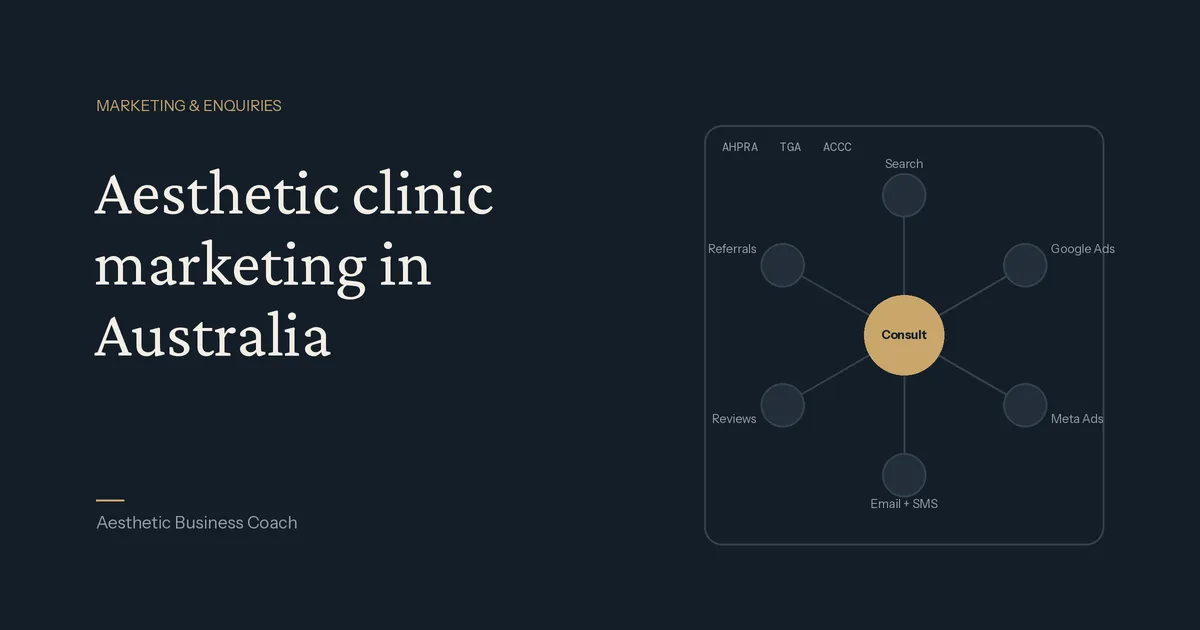
Three regulators. AHPRA enforces section 133 of the National Law for anyone advertising a regulated health service, plus specific cosmetic guidelines that came into force in September 2025. The TGA controls how therapeutic goods, including prescription medicines, can be advertised. The ACCC enforces Australian Consumer Law on pricing, discounts and misleading conduct, which applies to every business.
Here’s the short version of each, with the parts clinic owners trip on most.
AHPRA and the National Law
Section 133 says advertising a regulated health service must not be false, misleading or deceptive; must not offer a gift, discount or inducement without stating the terms; must not use testimonials about the clinical service; must not create an unreasonable expectation of beneficial treatment; and must not encourage indiscriminate or unnecessary use of health services.
On top of that, AHPRA’s guidelines for advertising higher risk non-surgical cosmetic procedures took effect on 2 September 2025. They cover cosmetic injectables, thread lifts, fat dissolving injections, PRP and similar. Among the requirements: advertising must not target people under 18, which on social platforms means marking it as adult content; influencer and patient testimonials are out; words like “safe” and “painless” are out; filters or tools that predict a post-procedure appearance are out; and adverts need to include risks and recovery information rather than glossing over them.
The testimonial rule catches more clinics than any other. Reviews on Google that you don’t control are generally fine to exist. Reposting one to your Instagram, or liking and sharing a patient’s comment about their treatment, turns it into your advertising.
The TGA Advertising Code
Prescription-only medicines (Schedule 4) can’t be advertised to the public. In practice that means you can’t name injectable brands in ads, posts, on your website or in a price list. You write “anti-wrinkle injections” or “dermal filler” and leave the brand for the consultation. Practitioner endorsements of a therapeutic good are also restricted. Device treatments registered with the TGA can be named and priced publicly, which is why they carry most of the direct response weight in compliant clinic marketing.
The ACCC and Australian Consumer Law
This one applies to everyone. Any price you show must be the total minimum price including GST and unavoidable fees. “Was $X, now $Y” needs a genuine prior selling price. Fake countdowns, invented scarcity and “only three spots left” that isn’t true are misleading conduct. Testimonials must be real. If you pay or reward someone for one, say so.
Should you fix compliance first or after the campaign is built?
First. Most owners write the ad, then sand off the risky bits, then hope. The sanding never ends and the fear never leaves. Clinics that build compliant from the first draft publish faster, adjust a line when guidance shifts instead of deleting a channel, and, in my experience, get better patients from the campaigns.
A story about a letter, details changed. The owner rang me on a Tuesday morning and I could hear it before she said anything. A letter had arrived from the regulator about her marketing. Not a fine. Questions. This ad, that post, those claims, please explain.
Her marketing had grown up the way most clinic marketing does. A template borrowed from a supplier. A couple of posts copied from a competitor who seemed to be doing well. A video made on a good day without anyone checking whether the rules that year allowed it. None of it had felt reckless. It had felt like keeping up.
We spent that afternoon reading. Every public thing the clinic had said in the previous year, laid out on one screen, next to what the guidance allowed. Some of it was fine. Some of it wasn’t, and she knew which before I said a word, because the cold flush she’d felt reading the letter was the same one she’d been quietly feeling every time she hit publish for months.
She responded honestly, took down what needed taking down, and then did the thing that turned a bad week into a good decision. She rebuilt instead of going quiet. Public content built around consultations, concerns, practitioner expertise and the patient experience. Device treatments, which can be named and priced, carrying the direct response weight. The conversations the rules reserve for one on one settings actually happening there, in the consult room, where they belong anyway.
The new campaigns worked better. Ads that sold trust in her and her clinic attracted patients who wanted her. The old ads had attracted people shopping for a product, and a product can always be found cheaper somewhere. Months later she told me she’d stopped dreading her own ad account.
Scroll your own public content this weekend as if you were the person writing that letter. Whatever you feel in your stomach is the truth about your marketing, and it’s far cheaper to act on it before the envelope arrives.
Which marketing channels actually book patients for a clinic?
Six, in the order I’d build them. Google search through your Business Profile and treatment pages. Google Ads for people searching right now. Meta ads for people who aren’t searching yet. Email and SMS to the list you already own. Reviews, gathered weekly. Referral partners nearby. Social content on its own builds familiarity and rarely books anyone directly.
Google search
Patients who are ready to book search for the treatment and their suburb. Your Google Business Profile decides whether you appear in the map results, and your treatment pages decide whether you appear below it. Both are free apart from your time. Most clinics have a half finished profile with old opening hours and a website that describes the clinic rather than the treatment someone typed. Fixing both is the highest return, lowest cost work in clinic marketing, which is why we run SEO for clinics as a standing service rather than a project.
Google Ads
Search ads put you in front of someone typing “laser hair removal Parramatta” at the moment they type it. They’re the fastest channel to test and the easiest to waste money on, because the platform will happily spend your budget on clicks that never become consultations. The campaign has to be built around device treatments and consultations, tracked to the booked appointment, and reviewed against cost to win a patient rather than cost per click. Injectable brand names can’t appear in the ad copy, which surprises owners who see competitors doing it. Those competitors are the ones getting the letters.
Meta ads
Facebook and Instagram reach people who haven’t searched yet. They’re the channel for building demand around a concern, a consultation offer or a practitioner story, and for retargeting people who visited your site and didn’t book. Meta’s own health advertising rules sit alongside AHPRA’s, and since September 2025 ads for higher risk procedures need to be restricted to adults. Lead forms inside Meta work well for consultations if, and only if, the reply comes within minutes. We covered why in the speed to lead post.
Email and SMS to your own list
The cheapest patients to win are the ones you already have. Most clinics hold hundreds or thousands of past patients in a database and email them once a year, if that. A monthly note from the practitioner, a reactivation message to anyone who hasn’t visited in six months, and a between visit check in for people mid plan. No ad spend, and the response rate embarrasses every paid channel.
Reviews
Reviews decide which clinic a patient rings after the search. Ask every happy patient, on a fixed day each week, with a direct link. Never repost them as your own advertising if they describe a regulated treatment, and never offer anything in exchange. A steady stream of recent reviews does more for a local clinic than most ad campaigns.
Referral partners
The hairdresser two doors down. The gym, the dentist, the naturopath. People who already talk to your future patients about how they look and feel. A referral relationship costs a coffee and a conversation, and it brings patients who arrive already trusting you. Keep it clean: no payments for referrals of regulated services, just genuine mutual recommendation.
Why does most clinic marketing fail after the click?
Because the clinic spends on the enquiry and nothing on what happens next. The ad works. The form gets filled in at 9pm. Nobody replies until 11 the next morning, the patient has booked elsewhere, and the owner concludes that Meta ads don’t work for clinics. The channel did its job. The 14 hours in between did the damage.
I’ve seen this more than any other failure in seven years of coaching. A clinic doubles its ad budget and doubles its enquiries, then wonders why bookings barely moved. Pull the numbers and the enquiry to consultation rate is 20%. Four out of five enquiries went nowhere, at full price.
The order is the same every time. Get the first reply automated on every channel. Write a follow up sequence for the enquiries that go quiet. Run consultations that end with a plan, a price and a date. Then spend. The growth guide covers the whole sequence in how to grow an aesthetic clinic, and it’s the reason ad management at Aesthetic Business Coach comes with the follow up system attached rather than as a separate conversation.
What does a month of clinic marketing look like?
One theme, one consultation offer, one afternoon of planning. Pick a concern your clinic treats well, build the month around it, and let every channel carry the same message in its own way. The plan lives on one page and the content gets made in a batch, so marketing stops being squeezed in late at night between patients.
Here’s the shape.
- Week 1. One long piece on the website about the concern: what it is, what a consultation covers, what treatment options exist, what recovery looks like. Written to the rules. This becomes the page your ads and posts point to.
- Week 2. Two short videos of the practitioner talking about the concern and the consultation. Not the treatment brand, not before and afters, just a person who knows what they’re talking about.
- Week 3. An email to the list about the concern, with a link to the page and a consultation booking link. A reactivation message to lapsed patients on the same theme.
- Week 4. Review the numbers. Enquiries by channel, cost to win a patient, consultation rate. Decide whether next month’s theme is a new concern or the same one, done deeper.
Google Ads and the Business Profile run underneath all of it, every month, because search demand doesn’t follow your content calendar. This is the Monthly Campaign Planner we use with coaching clients, and once you’ve run it three times the afternoon shrinks to an hour.
How do independent clinics out-market the chains?
By not copying them. Chains have brand budgets, bulk buying and a marketing department. They don’t have a face patients know, a front desk that greets people like neighbours, or a practitioner who remembers the name of your daughter. Their marketing has to be generic because their clinics are. Yours can be about a person.
The independent clinic’s marketing advantage is that the person in the video is the person in the room. Every piece of content that shows the practitioner, explains the consultation and describes the experience is content the chain can’t make, because their practitioner may be different next month. Match them on systems (reply speed, easy booking, professional follow up) and beat them on everything human. That’s most of the game.
How do you know if your marketing is working?
Track it to the booked treatment rather than the click. Cost to win a patient compared with what a patient is worth over twelve months. If you can’t say what a new patient costs and what they’re worth, you can’t say whether marketing is working, and you’ll make the decision on feelings.
Two numbers, checked monthly. Cost to win a patient: total marketing spend divided by new patients who actually booked a treatment. Average patient value: revenue divided by patients over the last twelve months. If the second is comfortably higher than the first, scale. If it isn’t, the problem is usually the process between enquiry and booking, and fixing that costs less than buying more enquiries.
Most owners have never seen these two numbers together. The first time they do, the argument about whether to spend more on marketing usually resolves itself.
Frequently asked questions
Can aesthetic clinics advertise in Australia?
Yes, within the rules. AHPRA’s National Law applies to any advertising of a regulated health service, the TGA restricts how therapeutic goods are advertised, and Australian Consumer Law applies to all pricing and claims. Clinics can advertise consultations, device treatments, practitioner expertise and the patient experience. What they can’t do is name prescription brands, use testimonials or promise outcomes.
Can I name injectable brands in my clinic’s ads or on my website?
No. Prescription-only medicines can’t be advertised to the public under the TGA Advertising Code, and that includes your website, price list and social posts. Use generic terms like “anti-wrinkle injections” or “dermal filler”. Brand conversations belong in the consultation. Competitors who name brands publicly are taking a risk you don’t need to share.
Are Google reviews allowed for aesthetic clinics under AHPRA?
Reviews on platforms you don’t control can exist. What AHPRA restricts is using testimonials in your own advertising. Reposting a review about a treatment to your Instagram, or liking and sharing a patient’s comment about their results, counts as advertising and breaches the rule. Ask for reviews, let them sit on Google, and don’t repurpose them.
What is the best marketing channel for an aesthetic clinic?
Google search, through your Business Profile and treatment pages, because it reaches patients who are ready to book and costs nothing but time. After that, Google Ads for immediate demand and your own email and SMS list for the cheapest bookings you’ll ever get. Social content builds familiarity but rarely books anyone on its own.
How much should a clinic spend on marketing?
Enough that cost to win a patient stays comfortably below what a patient is worth over twelve months, and no more until the process between enquiry and booking is converting. Fix reply speed, follow up and consultations first. A clinic converting 40% of enquiries needs half the ad budget of one converting 20% to get the same bookings.
Do I need a marketing agency for my clinic?
Not necessarily, and not first. Most clinics get more from fixing their own follow up, Business Profile and review rhythm than from any agency campaign. When you do bring in help, choose someone who tracks to booked treatments and understands AHPRA and TGA rules, because an agency that names injectable brands in your ads is creating your liability, not theirs.
Book a free 45 minute discovery call
Bring your last three months of marketing spend, enquiries and bookings. We’ll work out your cost to win a patient, check your public content against the current rules, and map which channel deserves the next dollar. No pitch, and you’ll leave knowing exactly where the money is going. Book your discovery call here.