Meta Ads for Cosmetic Clinics: What's Allowed and What Books
Facebook ads for cosmetic clinics are where most Australian clinic owners first spend real money on marketing, and where most of them first conclude that marketing doesn’t work. The ads usually did. The clinic behind them didn’t reply until the next morning, sent people to a homepage, or judged the campaign in its first week. This post covers what Meta ads are for, the three sets of rules that shape them, what the ad should actually be about, and what has to happen in the minutes after someone taps.
Do Facebook and Instagram ads work for cosmetic clinics?
Yes, for a different job than Google Ads. Search ads catch people who’ve decided they want a treatment. Meta ads reach people who haven’t searched yet, or who visited your site and left. They’re the channel for building demand around a concern, introducing the practitioner, and bringing back the people who were nearly ready.
Think of the two channels as a pair. Google Ads is the queue outside the door; the Google Ads guide covers that. Meta ads are the reason people join the queue next month. Someone scrolling Instagram at 9pm isn’t looking for a clinic. But a short video of a practitioner explaining what a consultation for their concern actually involves, from a clinic ten minutes away, plants something. Two weeks later they search.
Meta also does retargeting better than anything else. The person who read your laser hair removal page on Tuesday and didn’t book sees a gentle reminder on Thursday. That’s often the cheapest booking in the whole account.
Where Meta ads fail is when they’re asked to do Google’s job. Cold audiences don’t book treatments off an ad. They book consultations, if the ad is about them, and if the reply is fast.
What are the rules for cosmetic clinic ads on Meta?
Three layers. AHPRA’s advertising guidelines, which since September 2025 require higher risk cosmetic procedure ads to be restricted to adults and ban testimonials, “safe” and “painless” language, and filters. The TGA Advertising Code, which bans naming prescription medicines. Meta’s own health and personal attribute policies, which prohibit before and after images and anything that implies a negative self-perception.
Here’s how each one lands in an ad account.
AHPRA
Every rule from the AHPRA advertising guidelines post applies to Meta ads, plus the September 2025 additions for higher risk procedures like injectables, thread lifts and fat dissolving. Set the audience to 18 and over as a minimum. Mark the content as adult where the platform allows. No patient testimonials, no influencer endorsements, no “no downtime”, no language linking the procedure to confidence or happiness, and risks and recovery mentioned rather than hidden.
TGA
No injectable brand names in the ad, the caption, the landing page or the lead form. Prescription-only medicines can’t be advertised to the public. Write “anti-wrinkle injections” or “dermal filler” if you must name the treatment category, and build the ad around the consultation and the concern instead. Device treatments can be named and priced.
Meta’s own policies
Meta’s advertising standards prohibit “before and after” images in ads for personal health, and prohibit ads that imply or attempt to generate negative self-perception, including close ups of body parts presented as problems. They also restrict targeting on personal attributes, so an ad that says “struggling with your jawline?” is both an AHPRA risk and a Meta rejection. The workaround is the same as it always is: advertise the consultation and the expertise, not the flaw.
Clinics that build compliant from the first draft publish faster and get fewer rejections. Clinics that write the ad and sand off the risky bits afterwards live in the appeals queue.
What should the ad actually be about?
The concern, the consultation, the practitioner and the experience. Not the treatment brand, not the result, not the discount. A cold audience needs a reason to trust you before they’ll book anything, and the fastest way to build that in fifteen seconds of video is a real person explaining something clearly.
The formats that work, in rough order of reliability:
The practitioner talking to camera about a concern. What it is, what a consultation for it involves, what the options are, what to expect. No promises. Thirty seconds, phone quality is fine, subtitles on.
A walkthrough of what happens at a first visit. The welcome, the consultation room, the time taken. Sells the experience, which chains can’t copy.
A consultation offer with terms stated. What it includes, how long, with whom, what it costs or that it’s complimentary, and that treatment isn’t included. That last line keeps AHPRA happy and sets expectations.
Retargeting to site visitors with the specific treatment page they viewed. Short, direct, with a booking link.
A device treatment ad with the price. Named, priced including GST, with a booking step. This is where direct response lives in compliant clinic marketing.
What doesn’t work, or works and then costs you: discount-led injectable promotions, before and afters, “transformation” language, and stock footage of somebody else’s clinic.
One test for every ad. Would you be comfortable if a regulator, a competitor and your most loyal patient all saw it in the same hour? If any of the three makes you wince, rewrite it.
Lead forms or landing pages?
Lead forms convert more people and send you worse leads. Landing pages convert fewer people and send you better ones. Most clinics should run lead forms for consultation offers and landing pages for priced device treatments, and both only work if the reply arrives within minutes.
Meta’s instant forms keep the person inside the app, pre-fill their details, and convert at a much higher rate than sending someone to a website. The cost is quality. Some people tap through without much intent, and if your reply is slow, even the good ones cool off. Add one qualifying question to the form (“What are you hoping to improve?”) and accept slightly fewer, better leads.
Landing pages ask more of the person and reward you with someone who’s read about the treatment, seen the price and the practitioner, and still clicked. They suit device treatments where the price is public and the decision is closer.
Either way, the form or page should feed straight into your pipeline with an instant first message. Not “thanks, we’ll be in touch”. A real reply that asks a question and offers a time, sent in seconds, with a human finishing the conversation within the hour. The speed to lead post covers the setup, and it’s the reason our ad management comes with the follow up system attached rather than as a separate conversation.
What happens in the fourteen hours after the tap?
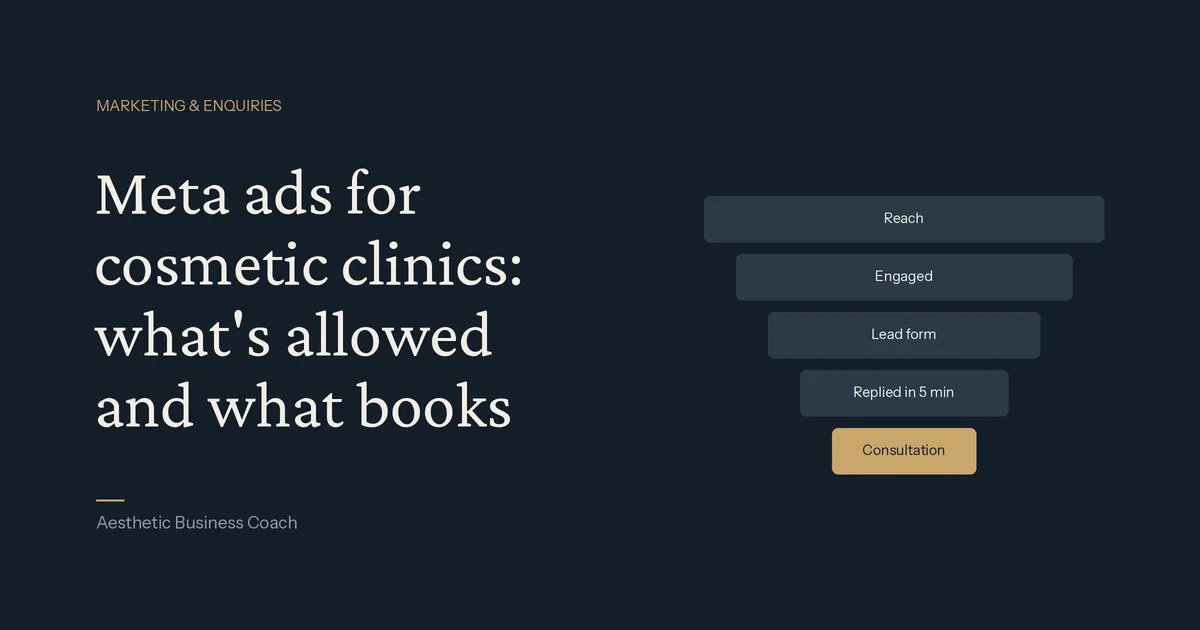
Meta campaigns live or die here. Someone fills in a lead form at 9pm. If they hear from you at 9:01, you have a conversation. If they hear from you at 11 the next morning, you have a lead who’s forgotten which clinic they enquired with, or booked with the one that replied. The ad worked. The clinic didn’t.
I’ve watched this more than any other failure with Meta ads. An owner doubles the budget, doubles the leads, and bookings barely move. Pull the pipeline and the median first reply is next business day. Four in five leads went nowhere, at full price, and the verdict was that Facebook ads don’t work for clinics.
The fix is the same as everywhere else in the clinic. Automated first reply in seconds, on every lead, at every hour. A follow up sequence for the ones that go quiet: day one, day three, day seven. A protected window each day for the front desk to finish the conversations that book. The enquiry to consultation rate tracked weekly, by campaign, so you can see whether the problem is the ad or the fourteen hours after it.
How do you know if Meta ads are working?
By counting consultations booked and treatments completed, per campaign, against spend. Not reach, not engagement, not cost per lead. A campaign with cheap leads that never book is expensive. Compare cost to win a patient against what a patient is worth in their first year, and give it six weeks before a verdict.
Meta will show you reach, impressions, engagement, video views and cost per result, and none of them tell you whether the campaign made money. The four lines that do: spend, enquiries, consultations, treatments. By campaign, monthly. If your agency’s report doesn’t have those four lines, ask for them.
Then hold your nerve. The follow up sequence converts the maybes from week one in week three. The retargeting audience takes a month to build. The practitioner video that felt awkward to film becomes the cheapest consultation source in the account somewhere around week five. Most owners kill the campaign in week one and cycle to the next tactic. The ones who wait get the compounding.
A note on virality, because it comes up. Years ago I posted something that took off by clinic standards: tens of thousands of views, hundreds of comments, notifications all day. It produced almost nothing, because it was interesting to everybody and relevant to almost nobody who could walk into my clinic. A hundred views from your suburb beats forty thousand from everywhere. That’s what paid targeting is for.
Frequently asked questions
Can cosmetic clinics advertise on Facebook and Instagram in Australia?
Yes, within three sets of rules. AHPRA’s guidelines apply to any advertising of a regulated health service, with extra restrictions on higher risk procedures since September 2025. The TGA bans naming prescription medicines. Meta’s own policies prohibit before and after images and negative self-image framing. Ads built around the consultation and the practitioner sit comfortably inside all three.
Can I advertise anti-wrinkle injections on Instagram?
You can advertise the consultation for that concern, but not the prescription medicine. No brand names anywhere in the ad, caption, form or landing page. Restrict the audience to adults, avoid “safe”, “painless” and confidence language, don’t use testimonials or filters, and mention risks and recovery. Most clinics find advertising the consultation and the practitioner works better anyway.
Are Meta lead forms good for clinics?
Yes for consultation offers, with two conditions. Add a qualifying question so you get fewer, better leads. Reply within minutes, automatically, at every hour, because lead form leads cool off faster than any other kind. A lead form with a next morning reply is the most common way clinics waste Meta budget.
Why do my Facebook ads get leads but no bookings?
Almost always the fourteen hours between the lead and the reply. Check your median time to first reply and your enquiry to consultation rate. If the reply is next business day, the ad did its job and the clinic lost the lead. Automate the first reply, add a follow up sequence, and give the front desk a daily window to finish the conversations that book.
What should a cosmetic clinic’s Facebook ad say?
Something a practitioner would say to a person in the room. What the concern is, what a consultation involves, what to expect, who they’d see. Short video of the practitioner to camera works best. For device treatments, name the treatment, state the price including GST, and offer a booking. No brand names, no before and afters, no discounts with a countdown.
How long should I run a Meta campaign before judging it?
Six weeks, with the follow up sequence running the whole time. The first week produces leads. The third week produces bookings from the first week’s maybes. The retargeting audience takes about a month to become useful. Owners who switch off in week one usually kill the campaign that would have worked by week six.
Book a free 45 minute discovery call
Bring your Meta ad account and your bookings from the last three months. We’ll work out cost to win a patient by campaign, check every ad against the three rule sets, and find out how many leads were lost in the fourteen hours after the tap. Book your discovery call here.