

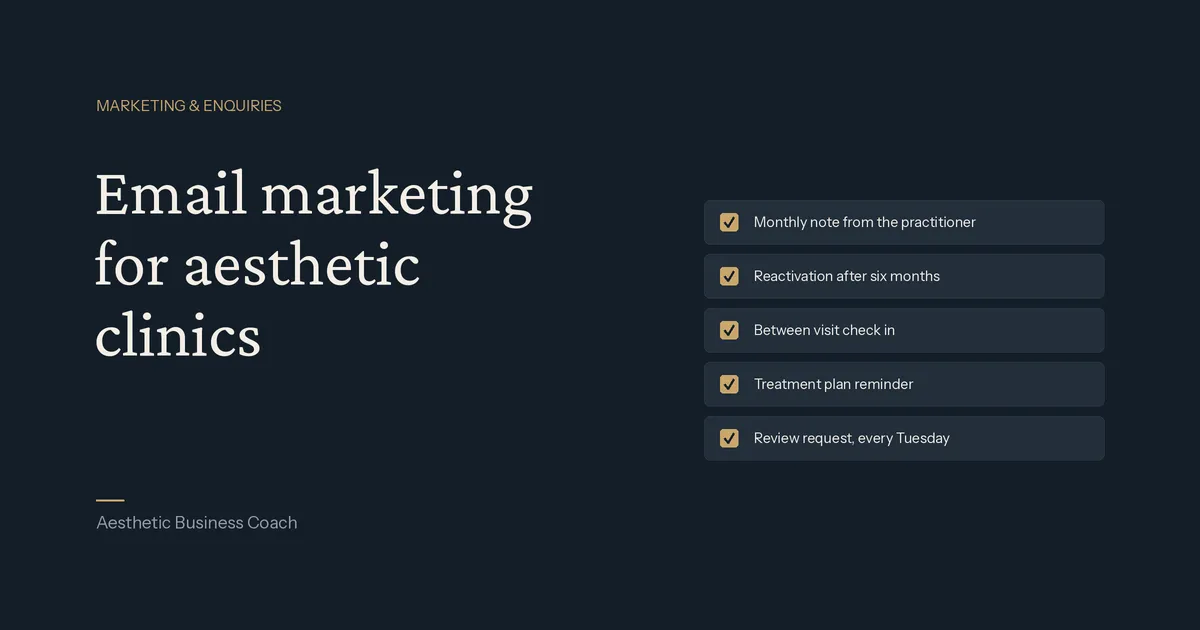
Email Marketing for Aesthetic Clinics: The List You Own
Email marketing for aesthetic clinics is the channel owners dismiss fastest and the one that, once switched on, tends to outperform everything they’re paying for. She had four thousand people on her database and had emailed them twice in three years. Within a few months of starting properly it was reliably her best performing channel. This post is why the list matters more than any social account, the three reasons owners stay silent, what to actually write, and how sorting the list into four piles changes what each message says.
Why is your email list worth more than your Instagram?
Because you own it. Your social account, its reach and its audience exist at the pleasure of a company that can change the rules any morning, and does. Your email and SMS list is people who gave you permission, and you can reach them without asking anyone. In a business where trust is the product, owned beats rented every time.
A story about a list, details changed. She had about four thousand people on her database. Patients past and present, enquiries, people who’d downloaded something years earlier, everyone the clinic had collected in a long time in business. She’d emailed them twice in three years.
When I asked why, the answer wasn’t laziness. It was three things, in order. She didn’t know what she’d say. She was worried about annoying people. She had a vague sense that email was old fashioned and everything happened on social media now.
Let me take those in reverse, because they’re the three reasons most clinics sit on the most valuable asset they own.
Isn’t email old fashioned?
No. Social media is where clinics rent attention from strangers, and it’s useful for that. Email and SMS are where clinics speak to people who already know them, and that’s where the bookings are. The channel isn’t old. The habit of using it is rare, which is exactly why it works.
Think about who’s on the list. Every person there has either been treated by you, enquired with you, or asked to hear from you. They’ve already crossed the hardest line in marketing: they know your name and have some reason to trust it. A social post reaches a slice of strangers the algorithm chooses. An email reaches everyone who said yes.
The numbers back this up in every clinic I’ve seen it done properly, and the reason is simple: a message from a practitioner you’ve met, about something you care about, gets opened. The patient lifetime value post explains why those people are worth many times a new enquiry.
Won’t regular emails annoy patients?
Only if they’re not worth reading. Nobody unsubscribes from things they enjoy. They unsubscribe from constant selling, which is a content problem rather than a frequency problem. One genuinely useful email a month, in the practitioner’s voice, with nothing sold in most of them, stays welcome for years.
The clinics that annoy their list send the same thing every time: an offer, a discount, a “book now”. After three of those, the patient has learned that every email is a sales pitch and stops opening. The clinics that stay welcome send things patients would actually forward to a friend. What to do about sun damage now that summer’s here. Why your practitioner recommends a course rather than a single session. The question everyone asks before their first laser appointment. The aftercare mistake almost everyone makes.
Two rules that keep it welcome. Write to one person, not to a list, because a message that sounds like a broadcast gets read like one. Let people leave easily, because a smaller list of people who want to hear from you is worth more than a large list quietly resenting you.
What should a clinic email actually say?
The things your patients ask you all day. What they ask before booking, what they worry about, what they get wrong about aftercare, what you wish everyone knew. That’s a year of content sitting in your consultation room already, in your patients’ own words. Write one a month, in the practitioner’s voice, and link to the treatment page.
Not knowing what to say is the easiest of the three problems to fix, because the answers are already in the building. Ask your front desk for the five questions they answered most last week. Ask your practitioner what she explained three times yesterday. Each one is an email.
The format that works: a subject line that’s the question. Two or three short paragraphs answering it honestly, the way the practitioner would in the room. One link to the page that goes deeper. One line at the end saying a consultation is the way to get an answer for you specifically, with a booking link. No banner, no five column layout, no stock photo of a woman touching her face.
Compliance applies to email exactly as it does to a website or an ad. No testimonials, no prescription brand names, no claims about results, terms on any offer, total prices including GST. The AHPRA guidelines post covers it; the short version is that a compliant email is also a better email, because it’s honest and specific.
How do you sort the list into four piles?
Export it and sort by last visit and by whether they ever booked. Active patients on their treatment rhythm. Lapsed patients, six months or more since their last visit. Enquiries that never booked. Voucher holders who haven’t redeemed. Four piles, an hour’s work, and the reason most mass emails fail is that they talk to all four at once.
Each pile needs a different conversation.
Active patients get recall reminders timed to their treatment windows, gentle and clinical, plus the monthly email.
Lapsed patients get a warm reactivation: “we’d love to see you again”, with an easy way back and no guilt attached. The reactivation post next month goes into this one.
Never booked enquiries get patient, unhurried nurture. Helpful things, a bit like these letters, with a consultation offered occasionally and never pushed.
Voucher holders get a friendly nudge and a booking link, well before the voucher expires.
All of it automated, all in the practitioner’s voice, all running without the owner. The device post tells the story of one owner who did this sort and found more bookings in the lapsed pile than in the enquiries she was paying for.
How should you use SMS alongside email?
SMS for anything short and time sensitive: reminders, follow up, a recall when a treatment window opens, a reply to an enquiry. Email for anything worth reading slowly: the monthly note, a treatment plan, an explanation. Both from the practitioner, in their voice. SMS is read within minutes; email is read when there’s time.
The mistake is using SMS for marketing. A text that says “20% off this week!” is intrusive, ignored, and a compliance risk. A text that says “Hi Emma, it’s Jess. Your next skin treatment window opens around now if you’d like to book: [link]” is helpful and gets a reply. Keep SMS personal and practical. Keep email for the longer conversation.
Two legal notes. The Spam Act requires consent and a working unsubscribe on commercial electronic messages, and that includes SMS. The Do Not Call Register doesn’t cover SMS, so consent is the thing to get right at the point of enquiry or booking.
How do you start if you’ve never emailed your list?
One email, this month, in the practitioner’s voice, answering the question the front desk hears most. No offer. Sort the list into four piles the same week. Set up the recall and reactivation automations next month. Then one useful email a month, forever. Within a quarter you’ll have a channel that costs nothing.
We started her with one email a month, useful, in her voice, nothing sold in most of them. Within a few months it was reliably her best performing channel. Email isn’t magic. Those four thousand people already knew her and had simply never been given a reason to think about the clinic.
Your database is the only marketing asset you own outright. Most clinics build it for years and then never speak to it, which is a bit like collecting phone numbers and never ringing anyone. Writing the monthly email and building the four pile automations is part of the marketing work in every coaching plan, and ClinicOS runs the sends. What’s included is on the pricing page. But the first email needs nobody. It needs a question your patients ask, and twenty minutes.
Frequently asked questions
Does email marketing work for aesthetic clinics?
Yes, and usually better than paid channels once it’s running, because everyone on the list already knows the clinic. One useful email a month in the practitioner’s voice, plus automated recall, reactivation and follow up messages sorted by patient type, produces bookings at almost no cost. The channel isn’t old fashioned. Using it well is just rare.
How often should a clinic email its patients?
Once a month for the general email, with automated messages on top: recall reminders when treatment windows open, reactivation after six months without a visit, follow up after enquiries and consultations. Monthly is enough to stay in mind without wearing out the welcome, as long as the email is worth reading.
What should I write about in a clinic newsletter?
The questions your patients ask every day. What to expect at a first visit, why a course beats a single session, the aftercare mistake everyone makes, what to do about sun damage in summer. Answer one honestly each month, in the practitioner’s voice, link to the treatment page, and offer a consultation at the end without pushing.
Do I need consent to email or text patients?
Yes. The Spam Act requires consent for commercial electronic messages, including SMS, and a working unsubscribe in every message. Get consent at the point of enquiry and booking with clear wording. Patients who’ve been treated by you and given their details will usually have consented; check your forms say so. Get legal advice on the exact wording.
Should I email lapsed patients?
Yes, warmly and without guilt. Sort your list so patients who haven’t visited in six months get their own message: “we’d love to see you again”, with an easy way to book. In the clinics I’ve done this with, the lapsed group often produces more bookings than new enquiries, because they already trust you and simply drifted.
Can I mention treatments in clinic emails?
Device treatments and consultations, yes, with the same rules as any advertising: no testimonials, no results claims, terms on any offer, total prices including GST. Prescription-only treatments can’t be advertised, so keep them out of the email and steer to the consultation. A compliant email is a more honest email, which is why it gets read.
Book a free 45 minute discovery call
Bring a rough count of your database and how many times you’ve emailed it this year. We’ll sort it into the four piles on the call, pick the first monthly email topic from your front desk’s questions, and map the automations that run the rest. Book your discovery call here.