

What Does an Aesthetic Business Coach Actually Do?
An aesthetic business coach is someone who’s run clinics, works alongside you on the parts of the business that aren’t the treatments, and turns what you already know is wrong into a sequence you can do. This post covers what a session includes, how it differs from hiring an agency, what happens on a discovery call, the honest story of a client we lost, and how to choose a coach without being sold to. I’ve done this for seven years after over 10 years owning UK clinics, so it’s written from inside the job.
What is an aesthetic business coach?
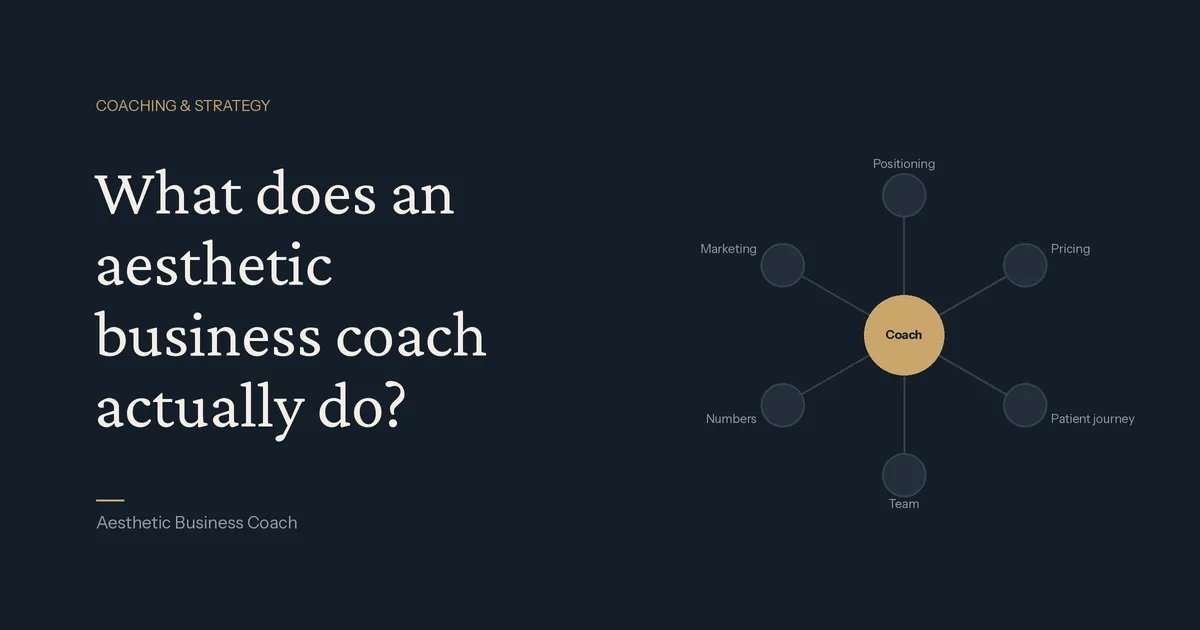
A clinic owner, current or former, who works with other owners on the business around the treatments. Positioning, pricing, patient journey, team, numbers and marketing, usually in that order. The good ones bring a system and the memory of having done it wrong themselves. The bad ones bring a framework they read about.
The word “coach” covers a lot. In this industry it ranges from someone who sells a course, to a consultant who writes a report, to a mentor who’s on a call with you every fortnight and in your Slack channel between them. I’d be careful of the first, cautious of the second, and I’d only pay for the third.
What separates a coach from a consultant is the ongoing relationship. A consultant hands you a plan. A coach stays until it’s done, adjusts it when reality intervenes, and holds you to it on the weeks you’d rather not. What separates a coach from a course is the specificity. A course teaches the general case. A coach looks at your diary, your numbers and your team, and tells you what to do on Monday.
What does a coaching session actually cover?
Whichever of the five foundations is limiting the clinic right now, worked through with your real numbers on the screen, ending with specific tasks for the next fortnight. Positioning, patient journey, offers, pricing, retention. Then, once those hold, marketing. Every session is recorded, so you’re not taking notes while you think.
The first session is nearly always the same. We pull the six weekly numbers (enquiries, enquiry to consultation, consultation to booking, show rate, average patient value, rebooking rate) and put them side by side, usually for the first time. That alone tells us where the leak is. The growth guide walks through those numbers and the order we’d fix things in.
From there, sessions follow the leak. If enquiries are going quiet, we’re writing the first reply and the follow up sequence and switching on the automation. If consultations end without a plan, we’re building the consultation framework and role playing the ending. If prices haven’t moved in four years, we’re doing the sums, writing the message to existing patients, and picking the date. If the owner is doing the diary, the enquiries and the marketing at ten at night, we’re working out what comes off their plate first and who takes it.
Between sessions, the work gets done. That’s the bit most coaching skips. With us, a team of ten builds what the session decided: automations, funnels, landing pages, campaigns, reporting. The owner asks, the team builds, the owner gets back to patients. What’s included in each plan is on the pricing page.
How is a coach different from a marketing agency?
An agency runs a channel. A coach works on the whole business and then decides which channels deserve budget. Agencies are paid to spend your money well. Coaches are paid to make the clinic worth spending on. Both can be right for you, and the order matters: fix the process, then buy the traffic.
Here’s the failure I see most. An owner hires an agency, the agency runs good ads, enquiries double, bookings barely move, and everyone blames the ads. Pull the numbers and the clinic was converting one enquiry in five, so the agency doubled the waste along with the enquiries. The agency did its job. Nobody was doing the other job.
A coach starts with the other job. Reply speed, follow up, consultation structure, pricing, retention. Once those convert, marketing spend produces patients instead of leads. At that point an agency, or an ad management team like ours, is worth every dollar, because the clinic behind the ads is ready for them.
The other difference is what happens when things go wrong. An agency whose ads underperform will suggest more budget or a new channel. A coach who’s watched the whole clinic will usually find the problem somewhere the ads can’t see: the receptionist who’s too busy to have the conversation, the consultation that ends with “have a think”, the price list that hasn’t moved. The marketing guide covers the channels. Coaching is about everything the channels land on.
What happens on a discovery call?
Forty five minutes, free, no pitch. You talk, mostly. By the time an owner books a call they already know what’s wrong, and the call is where they say it out loud to someone who won’t flinch. Then we map a first step for Monday, and we tell you honestly whether coaching is the right fit, including when it isn’t.
A story from a discovery call, details changed. She’d nearly cancelled twice. When she appeared on screen she started talking before I’d finished saying hello. The follow up leaked, she said. Enquiries sat in an inbox two people half checked. Her show rate was bad and she’d never measured it because she didn’t want to see the number. Her best practitioner was drowning in admin. She had a folder of ideas for fixing all of it, and the folder was two years old.
Then she stopped and said, why am I telling you this, you were going to ask me questions.
I hadn’t asked one. She’d done the whole diagnosis in four minutes, unprompted, and it was correct.
After seven years of these calls, that’s the pattern I’d bet the business on. I have never once told an owner something about their clinic that surprised them. The knowing is never the missing piece. What’s missing is a plan that turns a two year old folder into a first step, the confidence that it’s fixable in order, and someone to do it with who isn’t you at ten at night.
So the call is mostly listening, then a plan. If it’s a fit, we talk about how we’d work together. If it isn’t, you still leave with the first step and the order, and that’s fine. Some of the best calls I’ve had ended with “you don’t need us yet, do these three things and ring me in six months.”
We’ve lost clients too
We have, and pretending otherwise would insult your intelligence. The one that taught me most was an owner who left in month three because she’d expected more, and the failure was mine for not describing the curve before she paid for it. Month one is building. Month three is momentum. Month six is when it looks obvious in hindsight.
She joined with real energy. Good clinic, strong reputation, tired of guessing. The first month went the way first months go: systems wired, follow up switched on, campaigns built, a lot of activity behind the scenes and not much yet on the surface. Month two the same, with the first green shoots. Somewhere in month three she went quiet in Slack, then asked for a call, and told me politely and firmly that it wasn’t working. A friend’s agency had promised faster.
I did the wrong thing. I explained. I showed her the pipeline, the reviews starting to move, the enquiries that would compound if she held. All true, none of it landed, because I was explaining the shape of a curve to someone who’d never been told the curve had a shape. She left. A few months later I heard the friend’s agency hadn’t delivered faster either. I don’t tell that part with satisfaction. The story had no winner.
What I changed was the beginning. Every owner now hears, before any money changes hands, what month one, three and six look like. Other exits taught smaller lessons. The client who felt ignored during a busy fortnight gave us our response guarantees. The client who couldn’t see where the money went gave us the weekly hours update in Slack. Most of what we now call best practice is scar tissue from imperfect years.
How do you choose an aesthetic business coach?
Ask three things. Have they run a clinic themselves, and can they describe the unglamorous parts? What went wrong with a past client, and what did they change? What will month one, three and six look like if you start? The confident ones enjoy all three questions. The rest change the subject.
Some other things I’d look for. Whether the advice comes with implementation or just a plan, because most owners don’t need another plan. Whether they understand AHPRA and TGA rules well enough to keep your marketing compliant, because a coach who suggests reposting reviews is creating your liability. Whether every session is recorded and the plan is written down, so the work survives a busy fortnight. Whether they’ll tell you the smaller option is the right one, which is the fastest test of whether they’re on your side.
Companies with no scars have no history, and companies that hide their scars are usually hiding something else. Weigh anyone in this space by how they answer the question about what went wrong.
Frequently asked questions
What does an aesthetic business coach do that I can’t do myself?
Mostly, provide order and momentum. Owners already know what’s wrong. A coach turns that knowledge into a sequence, holds you to it on the weeks you’d rather not, and brings the memory of having fixed the same problems before. The specific tools (consultation frameworks, follow up sequences, pricing methods) can be learned. The time and the outside eye are harder to manufacture.
How is business coaching different from a marketing agency for clinics?
An agency runs a channel, usually ads or social media, and is paid to spend your budget well. A coach works on the whole clinic, from positioning and pricing to the patient journey, team and numbers, and then decides which channels deserve budget. Most clinics need the coaching work first, so the marketing spend lands on a process that converts.
Is a discovery call really free and without a pitch?
Yes. Forty five minutes, mostly listening, then a first step and an honest view of whether coaching fits. Some calls end with a recommendation to do three things yourself and come back later. The call is worth having even if you never work with us, because saying what’s wrong out loud to someone who’s fixed it before is usually the moment the folder of ideas becomes a plan.
How long does it take to see results from clinic business coaching?
Month one is building: systems, follow up, campaigns, mostly behind the scenes. Month three is momentum: steadier enquiries, better consultation outcomes. Month six is when the change looks obvious in hindsight. Owners who expect week one results tend to leave in month three, just before the compounding shows up.
What should I ask before hiring a clinic business coach?
Whether they’ve run a clinic themselves. What went wrong with a past client and what they changed as a result. What month one, three and six will look like. Whether implementation is included or just advice. Whether they understand AHPRA and TGA advertising rules. Whether they’d ever recommend the smaller option.
Does coaching include help with the marketing itself?
With us, yes. Every plan includes a team that builds what the sessions decide, and the larger plans include full ad management and SEO tracked to booked treatments. Coaching sets the direction and fixes the process. The team does the building. The pricing page lists exactly what’s included at each level.
Book a free 45 minute discovery call
Come with the thing you already know is wrong. You’ll say it out loud, we’ll put your numbers side by side, and you’ll leave with a first step for Monday and an honest answer about whether coaching is the right next move. Book your discovery call here.