

Aesthetic Clinic CRM Software: What to Look For
Aesthetic clinic CRM software is the purchase most owners get wrong twice: once by buying nothing and running the clinic from an inbox and a diary, and once by buying something enormous and using a tenth of it. I’ve done both. I’ve also built one, which you should know before reading this, because I’m going to try to be fair anyway. This post is the seven things a clinic CRM has to do, the features that look important and aren’t, an owner whose five tools had never met, and how to choose.
What is a CRM for an aesthetic clinic?
The system that sits between your marketing and your booking software and handles everything that happens to a person before they’re a patient, and between visits after that. Enquiries in, first reply, follow up, pipeline, consultation booked, reminders, aftercare, reactivation, review request, reporting. A booking system runs the diary. A CRM runs the relationship.
Most clinics have a booking system and think that’s the same thing. It isn’t. The booking system knows about people once they’ve booked. It has no idea about the person who filled in the web form at 9pm and never heard back, the Instagram DM nobody saw, the missed call at lunchtime, or the consultation that ended with “have a think”. Those people live in a gap between your marketing and your diary, and the gap is where most of the revenue leaks. A CRM exists to close it.
What must a clinic CRM actually do?
Seven things, and they’re all about the gap. Capture every enquiry from every channel into one place. Reply in seconds, automatically. Follow up the ones that go quiet. Show the pipeline from first contact to booked treatment. Record where each patient came from. Run the between visit messages. Report the numbers that matter without a spreadsheet.
Here’s each one, and what it looks like when it’s working.
Every channel into one inbox. Web forms, chat, missed calls, SMS, email, Instagram and Facebook DMs, all landing in one timestamped place. If DMs live on the receptionist’s phone, you don’t have this.
Instant first reply. A real message, in your voice, asking a question, sent in seconds on every channel at every hour. The speed to lead post explains why this one matters most.
Follow up sequences. Day one, day three, day seven for enquiries that go quiet, and a separate sequence for consultations that ended without a booking. Automatic, warm, stoppable the moment a human replies.
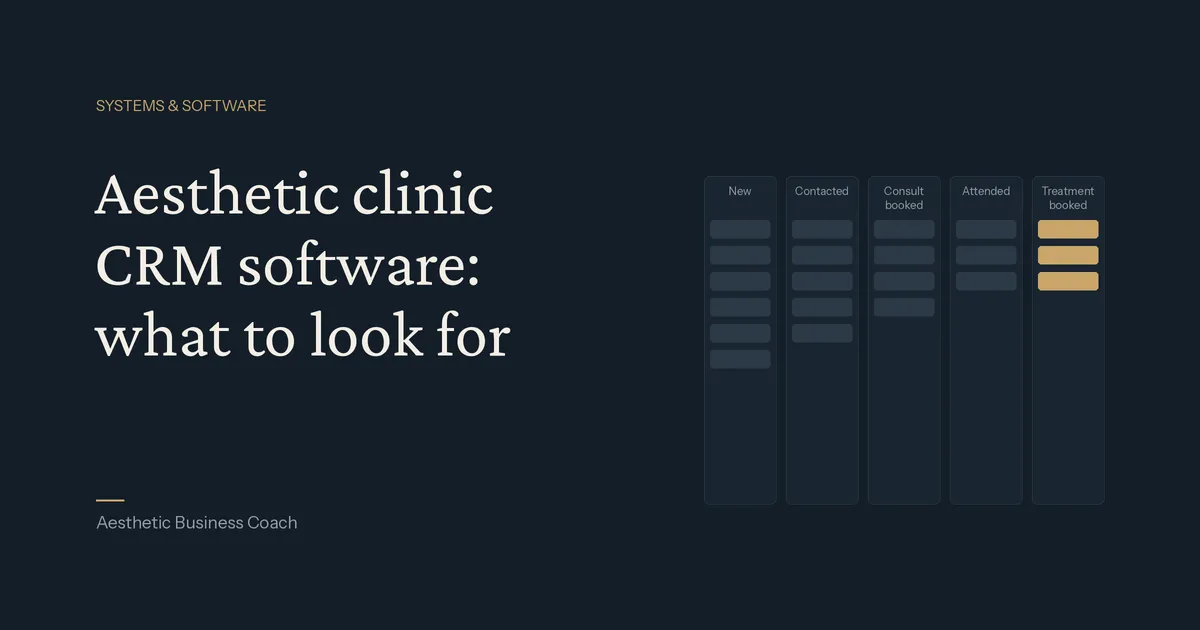
A pipeline you can see. Every enquiry as a card, moving from new to contacted to consultation booked to attended to treatment booked. One glance shows who needs a call and how much new business you’ve won this month.
Source on every patient. Which ad, which page, which referral. Without this you’ll never know what your marketing returns.
Between visit messaging. Reminders, aftercare, treatment plan check ins, reactivation after six months, review requests after treatment. Set once, running always.
Reporting without a spreadsheet. Enquiries, conversion rates, show rate, revenue by source, on one screen, weekly.
A system that does those seven things, reliably, in your voice, is a clinic CRM. Anything else is a bonus or a distraction.
Which CRM features don’t clinics need?
Most of the ones on the sales page. Complex lead scoring, custom dashboards for a sales team you don’t have, hundreds of integrations you’ll never connect, AI features that generate content you’d have to rewrite, and enterprise permission systems for a clinic of six. These features sell software to large companies and cost clinics money in setup time and confusion.
Some specific traps. A “pipeline” designed for B2B sales with stages like “proposal sent” and “negotiation” that you’d have to rename and rebuild. Email marketing tools that are powerful and so complicated nobody in the clinic will ever send a campaign. Reporting that shows three hundred metrics and hides the six you need. Anything where the demo is impressive and the setup takes a consultant.
The test is simple. Can your receptionist, on a busy Tuesday, see who needs a call back and make it without opening a second system? If the answer needs a training course, the tool is too big.
Why do clinics end up with five tools that don’t talk to each other?
Because each one was a good idea on the day it was bought, and nobody was responsible for the joins. An ads freelancer, a website designer, a follow up course half watched, an SEO person whose reports made no sense. Each piece competent. None in the same room. The owner becomes the integration, and the owner is already full.
George described his marketing like a house built by five contractors who’d never met. A freelancer running ads who’d never seen the website. A website built by a designer who’d never seen the ads, so people clicked on one thing and landed on another. A course about follow up with a workbook somewhere. An SEO person, briefly, whose reports he couldn’t read. He had plenty of clicks, a trickle of bookings, and no way to tell which piece was working, because nothing was measured end to end. He called it paying for a lot of good ideas that never met.
The turn came from a simple exercise. We drew his patient journey on one page: the ad someone saw, the page they landed on, what happened in the first five minutes after they enquired, what happened in the next week, how the consult ended, when they were asked for a review, when they were invited back. Then we marked where each of his contractors touched it. There were gaps you could drive a truck through, and two places where different pieces were actively working against each other.
So we joined them. The ads and the SEO built towards the same pages. Follow up caught every enquiry the ads produced. The consult framework fed the diary. Review requests fed the rankings, which fed free enquiries back to the top of the same page. Four months in, he had more enquiries than the clinic had ever seen and a cost per lead well down, because two specialists were pulling in one direction.
Compounding is arithmetic. Each system makes the next one work better, and the whole thing only adds up when the pieces are in the same room. That’s what a CRM is for, and it’s the reason to choose one that joins the pieces rather than one that becomes a sixth.
Should you use a generic CRM or one built for clinics?
Either can work. What matters is whether it does the seven things out of the box in a form your team will use, and whether the between visit messaging understands treatment rhythms. Generic CRMs can be configured to do all of it, but someone has to configure them, and that someone is usually you at ten at night.
I’ll declare the interest properly here. We built ClinicOS because clinic owners we coached didn’t need another app; they needed one place where enquiries, follow up, campaigns, bookings and reporting lived together and talked to each other. It does the seven things above by default, in the practitioner’s voice, with the automations pre-built. It comes included with every coaching plan and is available on its own. What’s included is on the pricing page.
I’ll also say plainly that it isn’t the only good option and that the principle matters more than the product. A clinic running a well set up generic CRM with the seven things working will beat a clinic with an expensive specialist tool nobody switched on. Choose the one your team will actually use, then use it.
How do you set up a clinic CRM so it gets used?
Switch on the automations that catch revenue first, in this order: missed call text back, form auto-reply, follow up sequence, reminder sequence, review request. Move the front desk’s morning routine into the pipeline. Then add the rest over a month. A CRM set up all at once on a Friday is abandoned by the following Friday.
The rollout that works:
Week one. Every channel into the inbox. Instant reply on all of them. Missed call text back live. This alone recovers the enquiries you didn’t know you were losing.
Week two. Follow up sequences for quiet enquiries and unbooked consultations, in the practitioner’s voice. Pipeline stages named the way the clinic talks.
Week three. Reminders with reschedule links, deposit terms in the confirmation, waitlist trigger. The no-shows post covers this sequence.
Week four. Review request after treatment, aftercare messages, reactivation for anyone six months lapsed. Source tracking on every enquiry.
Then. The weekly numbers on one screen, checked every Monday.
Every message in your voice. Patients should feel asked by you, not by software. Someone owns the system: a named person who checks the pipeline every morning and the numbers every week. A CRM without an owner drifts the same way a Business Profile does.
The “ClinicOS Foundations” course and the “Automations Library” in the Learning Academy walk through this build, and doing it with you is the implementation work in every plan. But the order above works on any platform.
How do you know the CRM is paying for itself?
Four numbers, before and after. Median time to first reply. Percentage of enquiries never replied to. Enquiry to consultation rate. Show rate. If the first two fall and the second two rise, the system is doing its job, and the revenue follows within a quarter. If they don’t move, the automations aren’t switched on or nobody owns them.
Most owners see the change in the first number within a week, because an automated reply in seconds replaces a human reply next morning. The conversion rate moves over the following month as the follow up sequences catch the maybes. The show rate moves once reminders and deposits are live. By the end of the quarter the reporting screen shows what the marketing returned, by source, for the first time, and that’s usually the moment the owner stops thinking of the CRM as software and starts thinking of it as the clinic’s memory.
Frequently asked questions
What is the best CRM for an aesthetic clinic?
The one your team will actually use that does seven things by default: captures every channel into one inbox, replies instantly, follows up automatically, shows a pipeline, records the source of every patient, runs between visit messaging, and reports without a spreadsheet. Clinic specific tools do this out of the box. Generic CRMs can be configured to, if someone does the configuring.
Do I need a CRM if I already have booking software?
Yes, because booking software only knows about people once they’ve booked. It has no idea about the web form at 9pm, the missed call at lunch, the DM nobody saw, or the consultation that ended without a plan. Those people live in the gap between your marketing and your diary, and a CRM exists to close that gap.
What should a clinic CRM cost?
Less than one patient a month. Work out what a patient is worth in their first year, then compare it against the subscription. A CRM that recovers even a couple of lost enquiries a month pays for itself many times over. Judge it on enquiry to consultation rate and show rate before and after, not on the feature list.
How long does it take to set up a clinic CRM?
Four weeks to do it properly, one week to get the revenue catching parts live. Instant replies and missed call text back in week one, follow up sequences in week two, reminders and waitlist in week three, reviews and reactivation in week four. Setting everything up at once and switching it all on together is how systems get abandoned.
Can a CRM send messages that don’t sound automated?
Yes, if every message is written in the practitioner’s voice before it’s loaded. The automation decides when a message is sent. You decide what it says. A follow up that reads like a person asking a question gets replies at 9pm. A follow up that reads like a template gets ignored. Write them yourself, or with someone who knows your voice.
Is ClinicOS a CRM?
Yes. It’s the clinic growth platform we built at Aesthetic Business Coach, and it does the seven things in this post by default, with the automations pre-built in the practitioner’s voice. It’s included with every coaching plan and available on its own. I built it, so read this post as one opinion among several and choose the system your team will use.
Book a free 45 minute discovery call
Bring a list of the tools your clinic currently uses and a rough count of last month’s enquiries by channel. We’ll draw your patient journey on one page, mark where the pieces don’t meet, and work out whether you need a CRM, a better setup of the one you have, or someone to own it. Book your discovery call here.