

The Empty Chair: How to Reduce No-Shows in Your Clinic
If you want to reduce no shows in your clinic, start by putting a number on them. Two cancellations on a Tuesday afternoon is four hours of a fully staffed, fully lit, fully rented clinic doing nothing, and you paid for those hours whether anyone sat in the chair or not. I ran my UK clinic for years telling myself that was the nature of the business. Then I fixed it in an afternoon. This post is the three changes, the deposit conversation I avoided for two years, and the moment a cancelled slot was refilled in twelve minutes.
What do no shows actually cost a clinic?
The full cost of the hour, because the cost of the clinic that day is already paid. Rent, wages, lighting, insurance, the device on standby. A no show saves none of it. It also costs the patient who would have taken the slot, and it tells your team the diary is a wish list rather than a plan.
I walked into my clinic one Tuesday morning and my receptionist told me, apologetically, that we had two cancellations for the afternoon. One at midday, one at half two. Both had rung with good reasons. Both were lovely about it.
That was four hours of a fully staffed clinic doing nothing. I remember standing at the desk doing the arithmetic in my head and then deciding, as I always did, that there was nothing to be done. Cancellations happen. It’s the nature of the business.
That sentence has cost this industry more money than any competitor ever has.
Count yours. No shows and late cancellations last month, multiplied by the average appointment value, plus the hours. Most owners have never done the sum, and the first time they do it stops being the nature of the business and starts being a line on the numbers page.
Why do patients not turn up?
Because nothing was exchanged and nothing was committed. To the patient, an appointment with no deposit and no reminder is a note in a calendar, and calendars change. They’re not being rude. They have no reason to think of the slot as real, because the clinic never treated it as real either.
The patient who finally moved me on this didn’t turn up for a ninety minute appointment, then rang two days later to rebook, entirely cheerfully, with no apparent awareness that anything had cost anyone anything. She wasn’t being difficult. Nothing had been exchanged. Nothing had been committed. The slot had been a note in her diary, and something came up.
Once you see it that way, the fixes are obvious. Make the slot real. A reminder that arrives at the right moment makes it real in the patient’s week. A deposit makes it real in their wallet. A waitlist makes a cancellation real to the clinic, because the gap gets filled instead of absorbed.
How do reminders reduce no shows without annoying patients?
By arriving at the right times, in the right tone, with a one tap way to reschedule. A reminder that only says “you have an appointment” is a nag. A reminder that says “here’s your appointment, tap here if you need to move it” turns most would be cancellations into moved appointments, which aren’t losses at all.
The cadence I’d use: a confirmation the moment they book, a reminder three days out with a reschedule link, and a reminder the morning of, or the evening before for early appointments. All in the practitioner’s voice, all short, all with the address and what to bring.
The reschedule link is the whole point. A patient who knows they can’t make Thursday will tap it on Monday if it’s easy, and the slot goes back into the diary with three days to refill it. Without the link, they’ll intend to ring, forget, and become a no show on Thursday.
Add a one line note on the cancellation policy in the three day reminder, kindly. “If you need to move it, tap here. Appointments moved with less than 24 hours’ notice may forfeit the deposit.” Nobody is offended by that. It’s what serious professionals do.
Should an aesthetic clinic take deposits?
Yes. A modest deposit at booking, credited against the treatment, refundable with reasonable notice. I avoided this for two years because I was certain it would offend people. It did the opposite. No shows dropped by more than half in the first two months, and patients started ringing to move appointments instead of quietly not appearing.
My reasoning for not taking deposits felt solid at the time. We were a caring clinic, not a nightclub. Asking for money upfront would signal we didn’t trust people. Patients would find it off putting and go somewhere that didn’t ask.
Meanwhile the no shows continued, and the late cancellations, and the Tuesday afternoons with a gap in the middle.
We introduced the deposit and I braced for complaints. There were almost none. Two people asked why. Both accepted the answer, which was simply that it holds your time and it comes off the price. Nobody stormed off. Nobody left a review about it. The whole thing I’d been afraid of for two years was entirely in my head.
The change went both ways. Patients treated appointments as commitments rather than intentions, and people organise their week around commitments. My team treated the diary differently too. When every booking is real, the schedule stops feeling like a wish list.
The wording matters more than the amount. “A deposit holds your appointment and comes off your treatment. It’s fully refundable with 48 hours’ notice.” Say it at booking, put it in the confirmation, and never apologise for it. Dentists do it. Specialists do it. Nobody thinks less of them.
Two things to get right. The deposit terms are part of your advertising if they appear in an offer, so state them clearly. Under Australian Consumer Law the cancellation terms need to be fair and disclosed before booking, not sprung afterwards.
How does a waitlist refill cancelled slots automatically?
Anyone who wants an earlier appointment goes on a waitlist when they book, with a note of which days suit. When a cancellation comes in, a message goes out automatically to everyone on the list whose preferences match the gap. First to reply takes the slot. No phone calls, no receptionist working a list, no gap costing money.
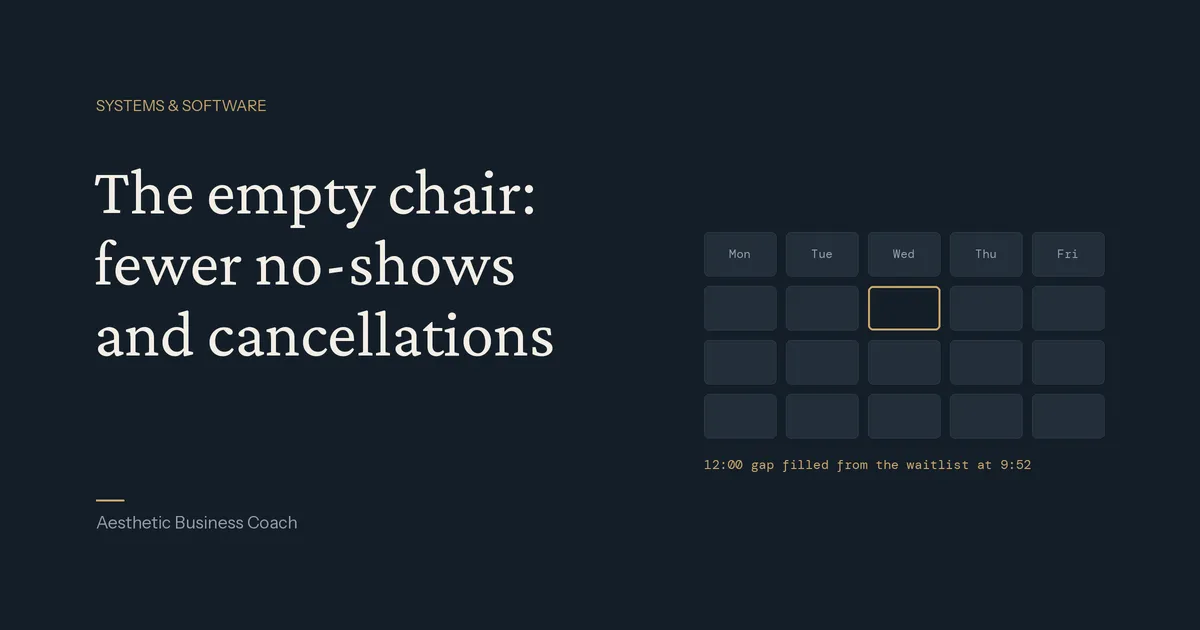
The first time it worked I didn’t believe it. A cancellation came in at nine forty in the morning and the slot was filled by nine fifty two, by a patient who’d been waiting a fortnight for an earlier appointment and was delighted.
Two things happen when you build this. The obvious one is that recovered hours are pure profit, because the cost of the clinic that day was already paid. The less obvious one is that patients start to feel differently about your diary. Being on a waitlist tells someone your time is worth having, and clinics that are worth waiting for get treated with more respect than clinics that always have something free tomorrow.
Setting it up took an afternoon. A waitlist field at booking. A trigger on cancellation. A message template. A rule that the first reply wins and everyone else gets a “sorry, that one’s gone, you’re still on the list” note. This is one of the automations ClinicOS runs by default, and it’s in the “Automations Library” template in the Learning Academy, but the logic works on any booking system that can send a message on a cancellation trigger.
What should the whole system look like together?
Deposit at booking, confirmation immediately, waitlist offered at the same moment, reminder three days out with a reschedule link, reminder the morning of, and an automatic waitlist message the moment anything is cancelled. Six steps, all automated, and the majority of the gap closes without anyone in the clinic doing anything on the day.
Here’s the sequence a patient experiences:
Books online or by phone. Pays a modest deposit. Ticks “I’d like an earlier appointment if one comes up” and picks days.
Gets a confirmation with the date, address, what to bring, and the deposit terms in one line.
Three days out, gets a reminder with a one tap reschedule link.
The morning of, gets a short reminder.
If they reschedule, the slot goes to the waitlist automatically. If someone else cancels a slot that suits them, they’re offered it.
If they don’t turn up, the deposit covers part of the loss and a kind message goes out asking if they’d like to rebook.
Between the reminders, the deposits and the waitlist, most clinics I’ve worked with close the majority of the gap. None of it needs more marketing. Every recovered hour comes from demand you already earned and paid for, and it arrives without a single extra enquiry. That’s the part I want you to sit with. Next time you hear yourself say it’s the nature of the business, check whether it’s actually the nature of the business or just the absence of a system.
Getting this built is part of the implementation in every coaching plan (details on the pricing page), and it’s usually the first thing we switch on, because it pays for itself in the first month.
Frequently asked questions
How do I reduce no shows at my clinic?
Three changes. Reminders at booking, three days out and the morning of, each with a one tap reschedule link so a cancellation becomes a moved appointment. A modest deposit at booking, credited against treatment and refundable with notice. A waitlist that automatically offers cancelled slots to patients who want an earlier time. Together they close most of the gap.
Should aesthetic clinics charge a deposit?
Yes. A deposit turns an intention into a commitment, and patients organise their week around commitments. Keep it modest, credit it against the treatment, make it refundable with reasonable notice, and state the terms at booking. In my clinic no shows dropped by more than half within two months and almost nobody complained.
What is a fair cancellation policy for a clinic?
Clear, disclosed before booking, and proportionate. A deposit refundable with 24 or 48 hours’ notice, forfeited for late cancellations or no shows, stated in the confirmation and the reminders. Under Australian Consumer Law the terms need to be fair and visible before the patient commits, so put them where they’ll be read, not in fine print.
How does a clinic waitlist work?
Patients who’d like an earlier appointment are asked at booking and note which days suit. When a cancellation comes in, a message goes automatically to everyone whose preferences match. The first to reply takes the slot; the rest stay on the list. It runs without the receptionist, and a cancelled slot can be refilled in minutes.
Do reminders actually reduce no shows?
Yes, when they include a reschedule link and arrive at the right times. A reminder without a way to reschedule is a nag. One with a link turns most would be no shows into moved appointments, which the waitlist then refills. Three days out and the morning of are the two that matter most.
What do I say to a patient who didn’t turn up?
Something kind, and something with a next step. “We missed you today. Everything okay? If you’d like to rebook, here’s a link.” Sent automatically the same afternoon. Most no shows are forgetful rather than rude, and a warm message recovers a good share of them. The deposit terms do the rest without anyone having to have an awkward conversation.
Book a free 45 minute discovery call
Bring last month’s no shows and late cancellations, and your average appointment value. We’ll put a number on the empty chairs, then map the reminder, deposit and waitlist setup so it’s running before the end of the month. Book your discovery call here.