
The Saturday I Wrote It All Down: SOPs for Aesthetic Clinics
Aesthetic clinic SOPs sound like the least interesting thing an owner could spend a weekend on, and for years I agreed. Then my most experienced practitioner called in sick and I discovered the clinic had never been running on a system. It had been running on her memory, and mine, and a few sticky notes. This post is what happened that Tuesday, what I wrote down the following Saturday, and the format that made the difference between a manual nobody reads and a set of pages the team actually uses.
Why does an aesthetic clinic need SOPs?
Because brilliant people accumulate the way things are done without anyone noticing, including them, and the clinic quietly becomes dependent on them being in the building. SOPs turn that accumulated knowledge into something the clinic owns. They’re what make a sick day, a holiday or a resignation an inconvenience rather than a crisis.
In my second year of running the UK clinic, my most experienced practitioner called in sick. Proper flu, a week off. I remember thinking we’d be fine. Full team, full diary, she was one person.
By ten in the morning I understood how wrong I was. Nobody knew how she set up the device for the afternoon treatments, because she always did it. Nobody knew which supplier the stock came from or that an order was due, because she always did it. Two patients rang to confirm their follow up plans, and the notes said “see previous”, and previous was in her head. By lunchtime we’d rebooked four appointments, apologised to six people, and I’d spent an hour on the phone to a supplier working out what a tick in a spreadsheet meant.
She wasn’t hoarding knowledge. She was excellent, and excellent people build up the way things are done without anyone writing it down. The clinic had worked right up until the moment one of the memories caught the flu.
That’s the case for SOPs in one story. It’s not about control or bureaucracy. It’s about the clinic being a business rather than a group of people who happen to work in the same rooms.
What should a clinic SOP look like?
One page per process. Plain language. Written in the order someone would need it, by someone who does it, and checked by someone who doesn’t. Not a manual. Nobody reads manuals, and a forty page document that lives in a drawer is worse than nothing, because it lets the owner believe the problem is solved.
That Saturday I sat in the empty clinic with a pot of coffee and a notebook and wrote down how things were actually done. The format that worked, and that I still use with clients:
A title that says what the process is, in the words the team uses. “How we open”, not “Morning operational procedures”.
Who does it and when.
The steps, numbered, in order, each one a single action. If a step needs explanation, it’s two steps.
Where things are. The login, the cupboard, the supplier’s number, the template.
What “done” looks like, so the person knows when to stop.
The date it was last checked and by whom.
If it doesn’t fit on one page, it’s two processes. If a new starter can’t follow it without asking, it’s not finished. The test I use is simple: could someone competent who’s never worked here do this tomorrow morning from the page alone? If not, the page is missing something, and the something is usually a detail so obvious to the person who wrote it that they forgot to include it.
It took the whole weekend and it was the least glamorous work I’ve ever done in this industry. It was also the moment the clinic became a business.
Which processes should you write first?
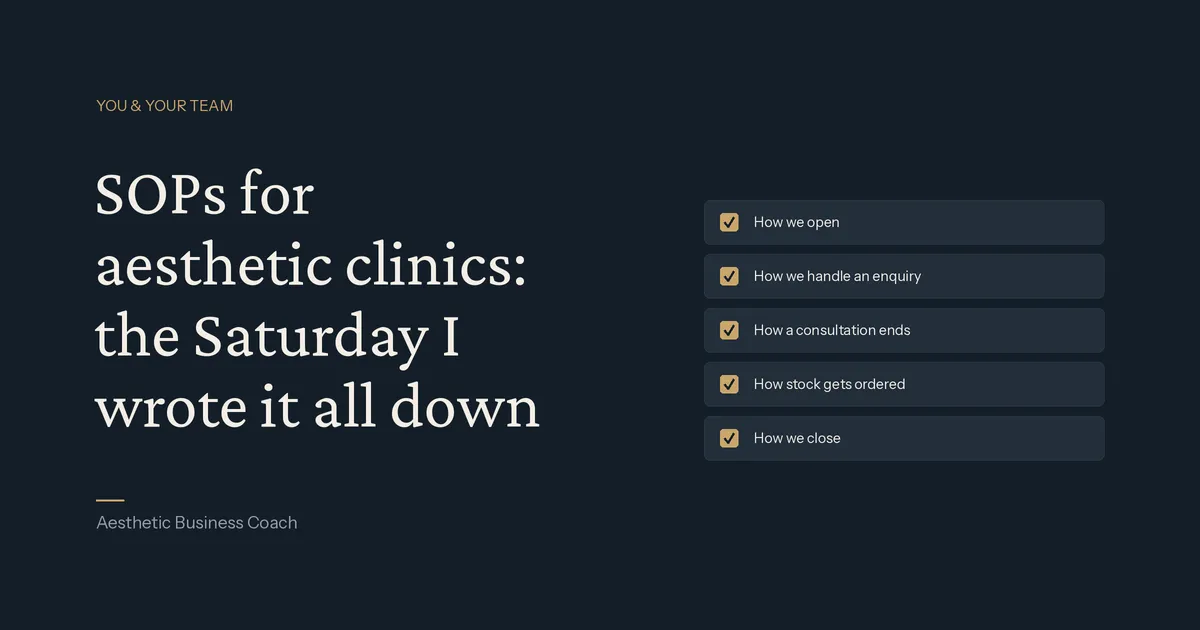
The six that stop the clinic when they fail: how you open, how you handle an enquiry, how each device is set up, how stock gets ordered, how a consultation ends and what happens after, and how you close. Write those first. They cover most of a normal day and all of a bad one.
Here’s why each one comes first.
How we open
Lights, systems, diary check, device warm up, stock check for the day, messages from overnight. The morning is where a missing step compounds through the whole day.
How we handle an enquiry
What happens in the first minute, who replies, what they say, where it gets logged, when it gets followed up. This is the process with the most revenue attached to it, and in most clinics it lives entirely in one person’s habits. The speed to lead post covers the process; the SOP is where it gets written down.
How each device is set up
One page per device per treatment. Settings, consumables, safety checks, cleaning, what to do when it errors. This is the page that was missing on the Tuesday my practitioner was off.
How stock gets checked and ordered
What we hold, minimum levels, who checks, which supplier, how to place the order, where the delivery goes. The tick in the spreadsheet that took me an hour to decode.
How a consultation ends
The recommendation, the plan, the price, the date, what gets recorded, and the messages that go out in the three days after. The consultation ending is where most clinics leak bookings, and it’s the process owners are most surprised to find they’ve never written.
How we close
Payments reconciled, devices shut down, stock noted, tomorrow’s diary checked, messages set for overnight. The close is where tomorrow’s problems get prevented.
Once those six exist, add the rest as they come up. Every time someone asks “how do we do X”, the answer is a page.
How do you get the team to actually use them?
Put them where the work happens, make them the answer to every “where is” and “how do I” question, and involve the team in writing them. A process written by the owner and handed down gets ignored. A process written by the person who does it, checked by the person who covers them, gets used because it’s theirs.
Three things made ours stick. The pages lived on the wall by the relevant station and in a shared folder on every device, so the answer was always closer than the person. The rule became that reception was no longer an information service: a practitioner leaning out of a room to ask where something was kept got pointed at the page, kindly, every time, until the question stopped. Every page had an owner who was responsible for keeping it true, which meant the people doing the work were the people improving it.
New staff learned the job in a week instead of three months, because there was something to learn from. My best practitioner took a fortnight off and I didn’t get a single phone call. When I eventually looked at selling the UK clinic, the folder of one page processes was worth more to the buyer than any piece of equipment, because it was the proof the clinic ran without me.
How do you keep SOPs alive?
Review every page once a quarter, update it the moment a process changes, and treat an out of date page as a bug rather than a document. The date at the bottom of each page is the mechanism. If it’s older than three months, someone reads it against reality and fixes what’s drifted.
Processes drift. A new device arrives, a supplier changes, a step gets skipped because it turned out not to matter. A page that describes how things used to be done is worse than no page, because a new starter will follow it faithfully. So the quarterly check is non-negotiable, and it’s a good job for whoever is newest, because they’ll read it literally and find the gaps.
The other thing that keeps them alive is using them for training. Every new starter learns the job from the pages, in order, with the owner of each page beside them. Every question they ask that the page doesn’t answer becomes an edit. Within a month you’ve got a set of processes stress tested by the person least likely to assume anything.
This is the “Team Playbooks and Onboarding” template in the Learning Academy, and building the first six pages with you is part of the implementation work in every coaching plan. What’s included is on the pricing page. But you don’t need us to start. You need a Saturday, a pot of coffee, and the honesty to write down how things are actually done.
Frequently asked questions
What are SOPs in an aesthetic clinic?
Standard operating procedures: written, one page descriptions of how each routine process in the clinic is done, by whom, in what order, and where the things needed for it are kept. They cover opening and closing, enquiries, device setup, stock, consultations and aftercare. Their purpose is to let the clinic run the same way regardless of who is in the building.
How long should a clinic SOP be?
One page. If a process needs more, it’s two processes and should be split. Long manuals don’t get read, and a document nobody reads gives the owner false confidence that the knowledge has been captured. The test is whether a competent new starter could follow the page tomorrow without asking anyone.
Who should write the SOPs?
The person who does the process, checked by the person who covers for them, with the owner reviewing. Processes handed down from the owner get ignored. Processes written by the team are used, because the team owns them and knows they’re accurate. The newest team member is the best reviewer, because they assume nothing.
Where should clinic SOPs be stored?
Where the work happens. A printed page by the relevant station and a shared digital folder accessible from every device in the clinic. The answer should always be closer than the person who’d otherwise be asked. If the SOPs live only in a binder in the office, they won’t be used.
How often should SOPs be reviewed?
Every quarter, and immediately whenever a process changes. Each page carries the date it was last checked. Anything older than three months gets read against reality and corrected. An out of date page is worse than no page, because a new starter will follow it exactly.
Do small clinics really need SOPs?
Small clinics need them most, because a small clinic is the most dependent on one or two people. A solo practitioner with a receptionist has two memories holding the business up. Writing down the six core processes is the difference between a sick day being an inconvenience and being a week of cancelled appointments and apologies.
Book a free 45 minute discovery call
Tell me which processes in your clinic live only in someone’s head. We’ll list them on the call, pick the six to write first, and I’ll walk you through the one page format so you can start this weekend. Book your discovery call here.